Achalasia Cardia: Symptoms, Causes, Types and Treatment
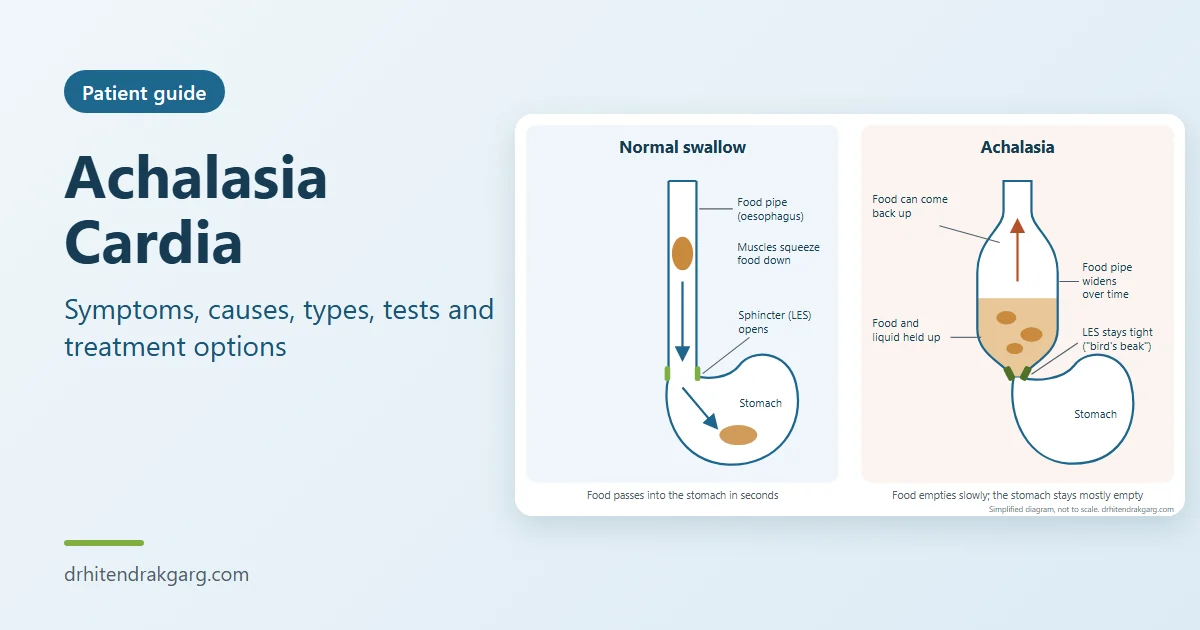
Achalasia cardia is a rare swallowing disorder. The muscle ring at the bottom of the food pipe stays tight, so food and water get held up in the chest.
In short
Achalasia cardia makes it hard to swallow both food and liquids, because the valve at the lower end of the food pipe does not open properly. The key test is high-resolution manometry. The nerve damage cannot be reversed, but treatments such as POEM, Heller myotomy and balloon dilation relieve the blockage for most people.
Many people with achalasia live with it for months, sometimes years, before they get the right diagnosis. Swallowing gets slowly harder. Food seems to stop in the chest. Some people start drinking water with every bite, and many are first told they have acidity. This guide explains what achalasia cardia is, the signs to watch for, how doctors confirm it, and the treatment options.
What is achalasia cardia?
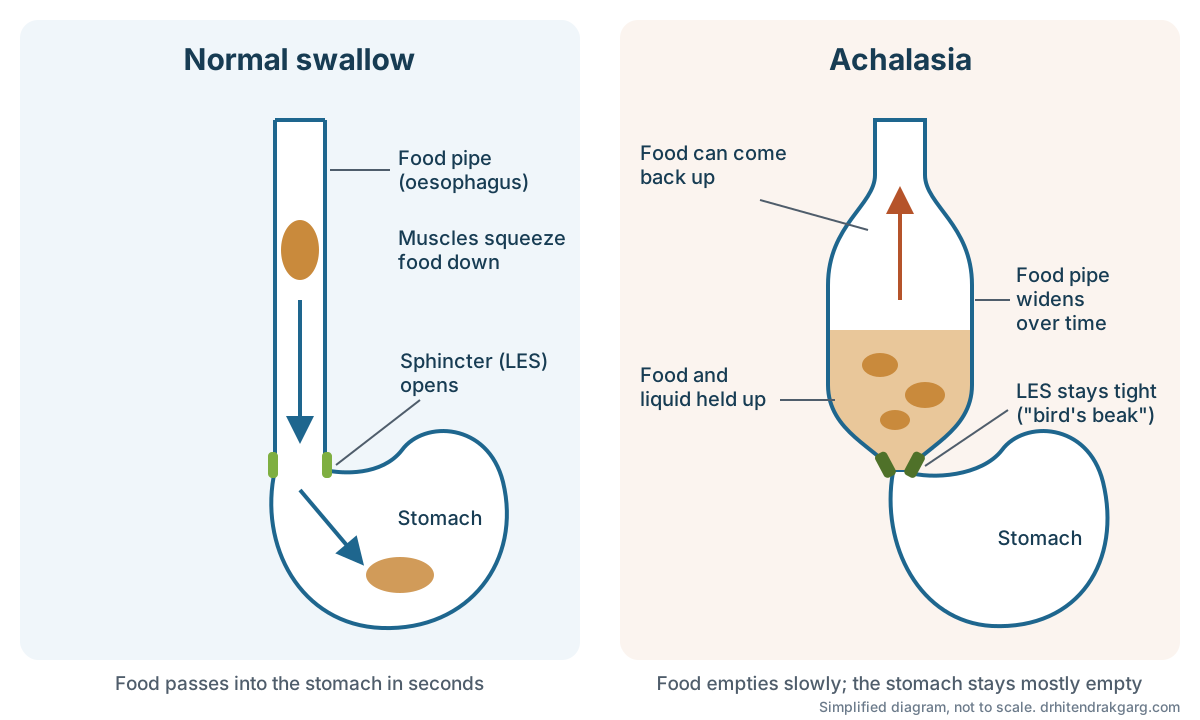
Achalasia cardia is a disorder of the food pipe (oesophagus). The valve at its lower end does not relax, and the food pipe stops squeezing normally, so food cannot pass easily into the stomach.
When you swallow, two things normally happen. Waves of muscle movement push food down the food pipe. At the same time, a ring of muscle at the bottom, called the lower oesophageal sphincter (LES), opens to let the food into the stomach. "Cardia" is the name for the upper part of the stomach, where the food pipe joins it.
In achalasia, the nerve cells that control these muscles are damaged or lost. The LES stays tight, and the pushing waves become weak or uncoordinated. Food and liquid collect in the food pipe. Over the years, the food pipe can stretch and widen.
Achalasia is rare. A population study from Alberta, Canada, found about 1.6 new cases per 100,000 people each year, and about 11 people in every 100,000 living with the condition (Sadowski and colleagues, Neurogastroenterology & Motility, 2010). It affects men and women, and it is most often diagnosed in adults.
Achalasia symptoms: what signs should you watch for?
The main symptom of achalasia is difficulty swallowing both solid food and liquids. Most people also bring back undigested food, and many have chest pain and weight loss (American College of Gastroenterology achalasia guideline, 2020).
1. Difficulty swallowing (dysphagia)
Food feels stuck behind the breastbone. In achalasia, liquids are often hard to swallow as well as solids. People may eat very slowly, drink water with each bite, or stand up to help food go down.
2. Bringing back undigested food (regurgitation)
Food comes back into the mouth without the force of vomiting. It is often food you ate hours earlier. It can happen after meals or at night, and some people find stains on the pillow in the morning.
3. Chest pain or pressure
Some people feel pressure or pain behind the breastbone, during or after meals. New, severe or unexplained chest pain must be checked urgently, because heart problems can feel the same.
4. Weight loss without trying
Eating takes longer and becomes uncomfortable, so people eat less. Weight loss is a reason to see a doctor soon.
5. A burning feeling, like heartburn
Some people feel burning in the chest. This is not always acid reflux. Food that sits and breaks down in the food pipe can also cause burning. This is one reason achalasia is often mistaken for acidity. Read how achalasia differs from GERD.
6. Coughing or choking at night
When you lie down, food or liquid held in the food pipe can come up into the throat. This can cause coughing, choking, a hoarse voice, or a chest infection if food goes into the windpipe.
Symptoms usually build up slowly, over months or years. Difficulty swallowing that lasts more than a few weeks should be checked by a gastroenterologist, even if you think it is only acidity.
What causes achalasia cardia?
In most people, the exact cause of achalasia is not known. Doctors do know what goes wrong: the nerve cells in the wall of the food pipe that tell the LES to relax are lost or damaged.
Why this happens is still being studied. Researchers have looked at immune reactions, possibly set off by a viral infection, in people who may be prone to them. No single cause explains every case.
Achalasia is not caused by spicy food, stress or ordinary acidity. It is not something you did.
Pseudoachalasia: when something else looks like achalasia
Sometimes a growth near the point where the food pipe meets the stomach, most often a cancer, narrows the area and causes the same symptoms. This is called pseudoachalasia. Doctors look harder for it when symptoms start quickly, weight loss is large, or the person is older. This is why an endoscopy is always part of the work-up.
What are the different types of achalasia?
Doctors divide achalasia into three types, I, II and III, based on the pattern seen on high-resolution manometry. This system is called the Chicago Classification (Chicago Classification version 4.0, Neurogastroenterology & Motility, 2021). The type helps doctors choose treatment.
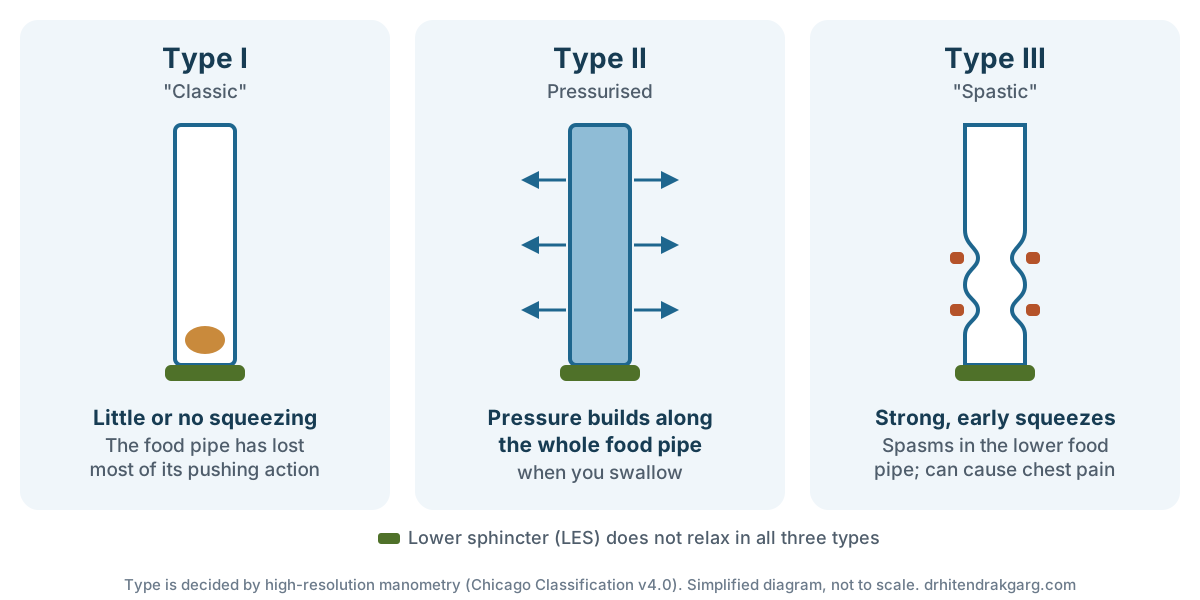
- Type I (classic): the food pipe barely squeezes at all. It has lost most of its pushing action.
- Type II: when you swallow, pressure builds up along the whole length of the food pipe at once.
- Type III (spastic): the lower food pipe gives strong, early squeezes, or spasms. Chest pain may be more common.
For types I and II, POEM, Heller myotomy and balloon dilation work about equally well, according to the American College of Gastroenterology. For type III, the same guideline prefers POEM or a tailored Heller myotomy over balloon dilation, because POEM lets the doctor make a longer muscle cut that covers the spastic part. Your age, health, earlier treatment and your own wishes also shape the choice.
How is achalasia cardia diagnosed?
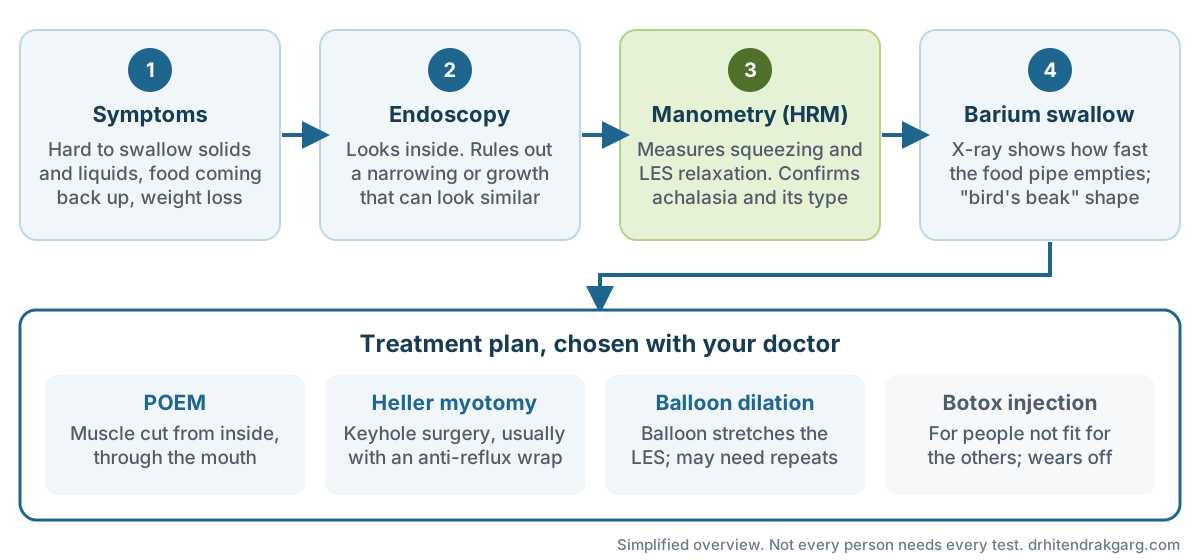
Achalasia is confirmed with high-resolution manometry. An upper GI endoscopy is done first to rule out a blockage or growth, and a timed barium swallow shows how well the food pipe empties.
Your history
The doctor asks what is hard to swallow, how long it has been going on, whether food comes back up, and how much weight you have lost. Bring any earlier reports and a list of your medicines.
Upper GI endoscopy
A thin, flexible camera is passed through the mouth to look at the food pipe and stomach. It checks for narrowing, inflammation or a growth. Food or saliva left in the food pipe is a clue to achalasia. Endoscopy can look normal in early achalasia, so it cannot rule it out on its own. If a growth is suspected, a CT scan or an endoscopic ultrasound (EUS) may be added.
High-resolution manometry (HRM)
A thin, soft tube is passed through the nose into the food pipe. It measures the pressure along the food pipe and at the LES while you swallow small sips of water. This is the key test. It confirms achalasia and shows the type.
Timed barium swallow
You drink a liquid called barium, and X-ray pictures are taken at set times. In achalasia, the barium empties slowly, and the lower end of the food pipe often looks narrow and pointed, like a bird's beak. This test is also useful for checking progress after treatment.
Doctors may also use a short symptom score, the Eckardt score, to measure how severe the symptoms are before and after treatment (Eckardt and colleagues, Gastroenterology, 1992). The ACG guideline also advises testing for achalasia when someone treated for GERD does not get better with acid-reducing medicine.
How is achalasia cardia treated?
Treatment loosens the tight LES so food can pass into the stomach. The three main options are POEM, laparoscopic Heller myotomy and pneumatic balloon dilation. Botox injection is kept for people who are not fit for these. No treatment repairs the nerve damage itself.
POEM (peroral endoscopic myotomy)
In POEM, an endoscope is passed through the mouth under general anaesthesia. The doctor makes a small tunnel inside the wall of the food pipe and cuts the tight muscle from the inside. There are no cuts on the skin. In a European trial of 221 patients, 83% had good symptom control two years after POEM, compared with 82% after Heller surgery (Werner and colleagues, New England Journal of Medicine, 2019). Reflux was more common after POEM. Read the full guide to POEM for achalasia, including preparation, recovery and risks.
Laparoscopic Heller myotomy
A surgeon cuts the LES muscle from the outside, through small keyhole cuts in the abdomen. A partial wrap of the stomach (fundoplication) is usually added to lower the risk of reflux afterwards. It is a well-established treatment with long experience behind it.
Pneumatic (balloon) dilation
A balloon is placed in the LES during an endoscopy and inflated to stretch and tear the tight muscle. Many people need more than one session. In a trial of 133 newly diagnosed patients, treatment was still working at two years in 92% after POEM and 54% after two planned balloon dilations (Ponds and colleagues, JAMA, 2019). There is a small risk of a tear in the food pipe, so it should be done by an experienced team.
Botulinum toxin (Botox) injection
Botox is injected into the LES during an endoscopy to relax it. Its effect wears off, often within months, so it is mainly used for people who are too frail or unwell for the other options.
Medicines and eating habits
Some medicines that relax smooth muscle can be tried when other treatments are not possible, but they help only a little and can cause headaches or dizziness. Acid-reducing medicines do not open the LES. Don't stop your prescribed medicines without talking to your doctor.
Achalasia treatment options compared
| Option | How it is done | Skin cuts | Good to know |
|---|---|---|---|
| POEM | Endoscope through the mouth; muscle cut from inside the food pipe | None | Lets the doctor make a longer cut, which helps in type III. Reflux is common afterwards |
| Heller myotomy | Keyhole surgery; muscle cut from outside, usually with a partial wrap | Several small cuts | The wrap lowers the reflux risk compared with POEM |
| Balloon dilation | Balloon stretches the LES during endoscopy | None | Often needs repeat sessions. Small risk of a tear |
| Botox injection | Injection into the LES during endoscopy | None | Effect wears off. Mainly for people not fit for the others |
The right option depends on your achalasia type, your age and health, any earlier treatment and your own preference. Your gastroenterologist will talk through the benefits and risks of each.
Is achalasia curable?
No. Achalasia cannot be reversed, because treatment does not bring back the lost nerve cells. It can, however, be treated well. Most people swallow much better after POEM, Heller myotomy or balloon dilation, and many stay well for years.
Symptoms can return over time, and some people need a second treatment. Reflux is also common after treatments that loosen the LES. In a review of 17 POEM studies, 29% of patients had reflux inflammation on endoscopy afterwards, compared with 7.6% after Heller myotomy with a wrap (Repici and colleagues, Gastrointestinal Endoscopy, 2018). This is usually controlled with medicines. For these reasons, follow-up continues for life, often with a repeat endoscopy. Learn more about GERD symptoms and treatment.
Living with achalasia: tips for eating
Simple eating habits can make meals easier while you wait for tests or treatment, and after treatment. They do not fix the tight muscle, so they are not a substitute for medical care.
- Eat slowly. Take small bites and chew well.
- Sip water during meals to help food go down.
- Sit upright while eating, and stay upright for a while after meals.
- Choose softer foods on bad days. See these easily digestible Indian foods.
- Avoid eating late at night, and raise the head end of your bed if food comes up when you lie down.
- Keep track of your weight. Tell your doctor if you are losing weight.
Achalasia cardia: myths and facts
Achalasia is rare, so there is a lot of confusion about it. Here are common myths, and what is actually true.
| Myth | Fact |
|---|---|
| Achalasia is a kind of acidity. | It is a nerve and muscle problem of the food pipe. Acid medicines do not loosen the tight muscle. |
| Spicy or oily food causes achalasia. | Diet does not cause achalasia. It comes from loss of nerve cells in the wall of the food pipe. |
| A normal endoscopy rules out achalasia. | Endoscopy can look normal in early achalasia. Manometry is the test that confirms it. |
| Achalasia always needs open surgery. | Most treatment today is through the mouth (POEM or balloon dilation) or by keyhole surgery (Heller myotomy). |
| Once treated, no follow-up is needed. | Symptoms and reflux can come back. Regular follow-up is advised. |
| Only older people get achalasia. | It can start at any adult age, and rarely in children. |
When should you see a gastroenterologist?
See a gastroenterologist if swallowing has been difficult for more than a few weeks, if food keeps coming back up, or if you are losing weight without trying. Also get checked if "acidity" does not improve with treatment, or if it is getting worse. Read when daily acidity needs attention.
Get urgent medical help if food is completely stuck and you cannot swallow your own saliva, or if you have severe chest pain, trouble breathing, vomiting of blood or black stools.
Frequently asked questions
What is the main cause of achalasia cardia?
Achalasia is caused by loss of the nerve cells that control the lower food pipe and its valve (the LES). Why these nerves are lost is not fully known. An immune reaction, possibly after a viral infection, is one explanation being studied.
Is achalasia the same as acidity or GERD?
No. In GERD, stomach contents flow back up into the food pipe. In achalasia, food cannot get down because the valve stays tight. Both can cause burning and regurgitation, so tests are needed to tell them apart. See achalasia vs GERD.
Can achalasia make it hard to swallow liquids too?
Yes. Difficulty swallowing both liquids and solid food is typical of achalasia. Many other swallowing problems affect solid food first.
Which test confirms achalasia?
High-resolution manometry confirms achalasia and shows its type. An upper GI endoscopy is also needed to rule out a growth or narrowing, and a barium swallow shows how well the food pipe empties.
Can achalasia come back after treatment?
Yes, symptoms can return months or years later, and some people need a second treatment. Regular follow-up helps catch this early. Reflux after treatment is also common and is usually controlled with medicines.
Can young people get achalasia?
Yes. Achalasia can start at any adult age, and it rarely affects children. Difficulty swallowing at any age should be checked by a doctor.

References
- Vaezi MF, Pandolfino JE, Yadlapati RH, Greer KB, Kavitt RT. ACG Clinical Guidelines: Diagnosis and Management of Achalasia. Am J Gastroenterol. 2020;115(9):1393-1411. Source
- Sadowski DC, Ackah F, Jiang B, Svenson LW. Achalasia: incidence, prevalence and survival. A population-based study. Neurogastroenterol Motil. 2010;22(9):e256-261. Source
- Yadlapati R, Kahrilas PJ, Fox MR, et al. Esophageal motility disorders on high-resolution manometry: Chicago classification version 4.0. Neurogastroenterol Motil. 2021;33(1):e14058. Source
- Eckardt VF, Aignherr C, Bernhard G. Predictors of outcome in patients with achalasia treated by pneumatic dilation. Gastroenterology. 1992;103(6):1732-1738. Source
- Werner YB, Hakanson B, Martinek J, et al. Endoscopic or Surgical Myotomy in Patients with Idiopathic Achalasia. N Engl J Med. 2019;381(23):2219-2229. Source
- Ponds FA, Fockens P, Lei A, et al. Effect of Peroral Endoscopic Myotomy vs Pneumatic Dilation on Symptom Severity and Treatment Outcomes Among Treatment-Naive Patients With Achalasia: A Randomized Clinical Trial. JAMA. 2019;322(2):134-144. Source
- Repici A, Fuccio L, Maselli R, et al. GERD after per-oral endoscopic myotomy as compared with Heller's myotomy with fundoplication: a systematic review with meta-analysis. Gastrointest Endosc. 2018;87(4):934-943. Source
Medical disclaimer: This article is for general education and is not a substitute for a consultation. Please see a doctor for advice about your own symptoms. Read our editorial policy.