Achalasia vs GERD: How to Tell the Difference
Difficulty swallowing, food coming back up and a burning chest can point to GERD, or to a rarer condition called achalasia. They need very different treatment.
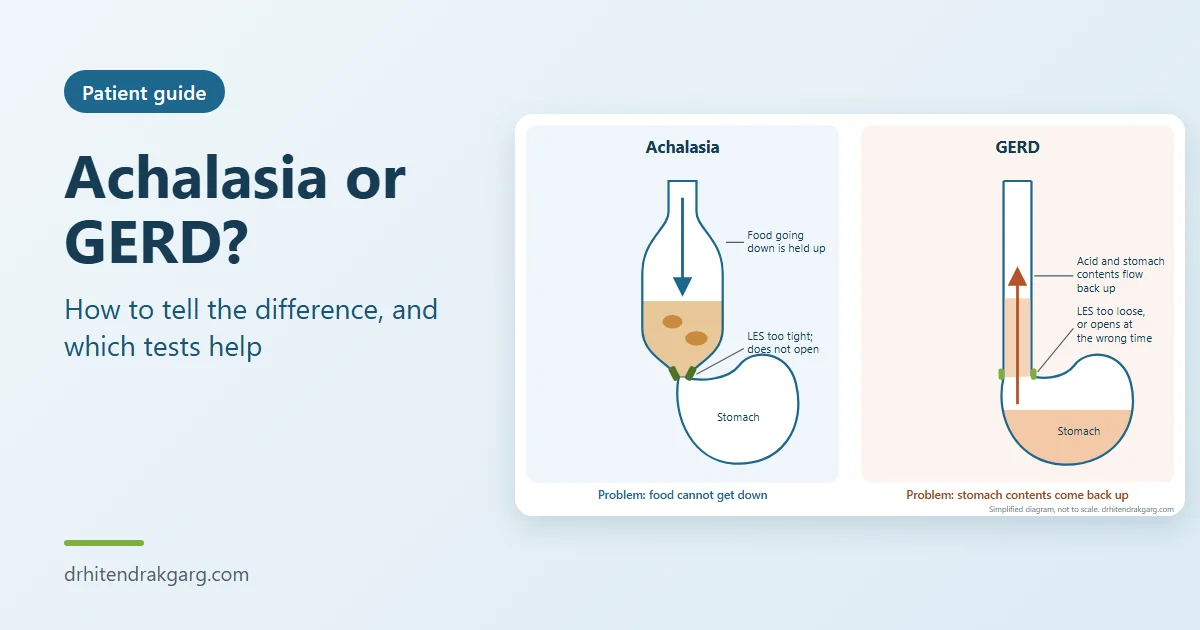
In short
GERD is when stomach contents flow back up into the food pipe. Achalasia is when food cannot get down, because the valve at the bottom of the food pipe stays tight. Both can cause burning and regurgitation, so symptoms alone cannot tell them apart. Manometry confirms achalasia; reflux monitoring confirms GERD.
Many people with achalasia are first treated for acidity. That is easy to understand. Both conditions can cause a burning chest, food coming back up and trouble at night. But GERD is very common and achalasia is rare. And the two need very different treatment. This guide explains how they differ, which clues help, and which tests give a clear answer.
Achalasia vs GERD: what is the main difference?
The main difference is the direction of the problem. In GERD, stomach contents flow backwards up into the food pipe. In achalasia, food cannot get down into the stomach, because the valve at the bottom of the food pipe stays tight.
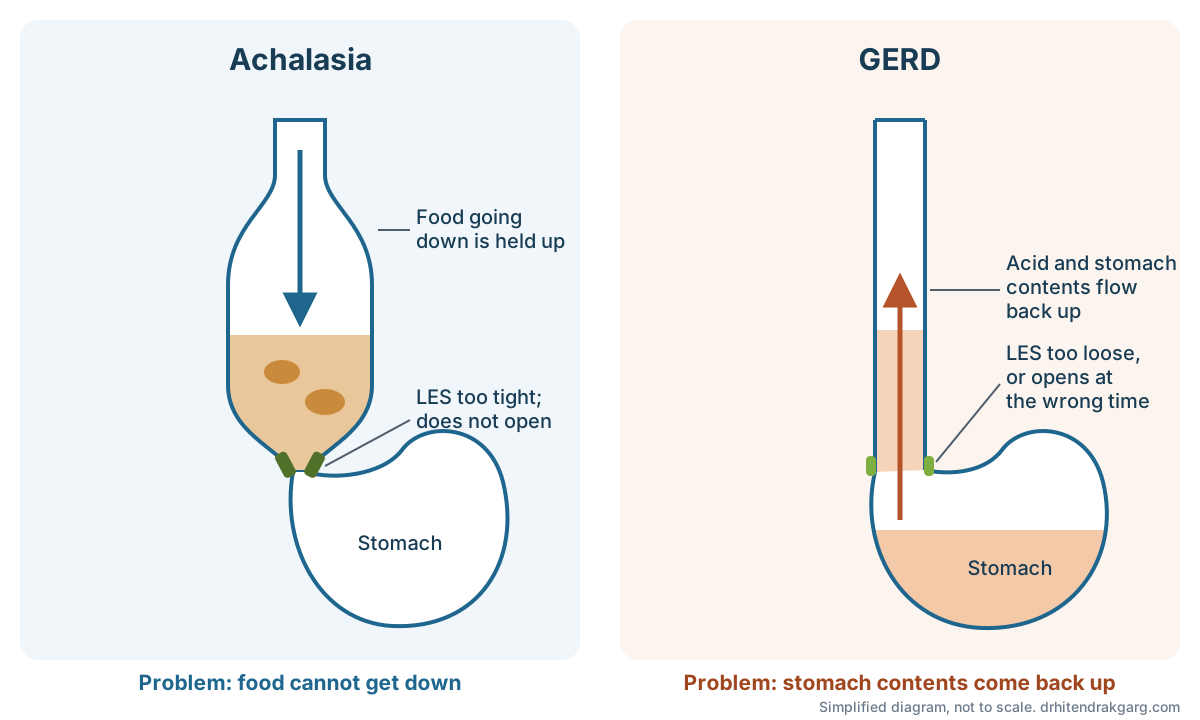
Both involve the same valve, the lower oesophageal sphincter (LES). In GERD, it is too loose or opens at the wrong time. In achalasia, it is too tight and does not open when you swallow.
| Feature | Achalasia | GERD |
|---|---|---|
| Main problem | Food pipe does not squeeze normally; the LES does not relax | Stomach contents flow back up into the food pipe |
| How common | Rare: about 1 to 2 new cases per 100,000 people a year | Very common: weekly symptoms in about 1 in 13 Indian adults |
| Difficulty swallowing | The main symptom; affects liquids as well as solids | Less common; usually a sign of inflammation or narrowing |
| Heartburn | Can occur, but is not usually caused by acid | The main symptom |
| What comes back up | Undigested food or liquid, often hours after eating | Sour or bitter stomach contents, often after meals |
| Weight loss | Common, because eating becomes hard | Not typical; needs checking if present |
| Acid-reducing medicines | Do not fix the problem | Usually help |
| Key test | High-resolution manometry | Often symptoms and response to treatment; reflux monitoring if unclear |
| Main treatments | POEM, Heller myotomy, balloon dilation | Lifestyle changes and acid-reducing medicines |
These are general patterns, not rules. Symptoms overlap, and a few people have both problems.
What is GERD?
GERD (gastroesophageal reflux disease) is a long-term condition. Stomach contents keep flowing back up into the food pipe, which causes symptoms or damage.
It is very common. An Indian Society of Gastroenterology survey found that 7.6% of Indian adults have heartburn or regurgitation at least once a week (Bhatia and colleagues, Indian Journal of Gastroenterology, 2011). Worldwide, the figure is about 13% (Eusebi and colleagues, Gut, 2018).
Common GERD symptoms include:
- Heartburn: a burning feeling behind the breastbone, often after meals
- Acid regurgitation: sour or bitter fluid coming up into the throat or mouth
- Symptoms after large meals or on lying down
- Chest discomfort, which must never be assumed to be reflux without checking the heart
- Cough, hoarseness or throat clearing, which can also have many other causes
Occasional acidity after a heavy meal is not GERD. Read about how acidity and GERD differ, and the full guide to GERD symptoms and treatment.
What is achalasia?
Achalasia is a rare disorder in which the nerves of the food pipe are damaged. The LES does not relax, and the food pipe stops pushing food down properly. Food and liquid collect in the chest.
A population study from Canada found about 1.6 new cases per 100,000 people each year (Sadowski and colleagues, Neurogastroenterology & Motility, 2010). That is why many doctors think of GERD first.
Common achalasia symptoms include:
- Difficulty swallowing solid food and liquids, with food feeling stuck in the chest
- Regurgitation of undigested food, sometimes hours after eating or at night
- Chest pain or pressure
- Weight loss, because eating becomes hard
- Coughing or choking at night
- A burning feeling that can be mistaken for heartburn
Read the full guide to achalasia cardia: symptoms, causes and types.
Achalasia vs acid reflux symptoms: how can you tell them apart?
Some patterns give useful clues, but none of them is proof. Only tests can confirm which condition you have.
Trouble swallowing liquids as well as food
In achalasia, liquids are often as hard to swallow as solids, from early on. In GERD, swallowing trouble is less common. When it happens, it is usually with solid food, because of inflammation or a narrowing (stricture).
Burning and a sour taste
Heartburn with a sour or bitter taste is the classic sign of GERD. People with achalasia can feel burning too. But it often comes from food sitting and breaking down in the food pipe, not from stomach acid.
What comes back up, and when
In achalasia, what comes back is often undigested food or liquid, sometimes hours after a meal. In GERD, it is usually sour fluid soon after eating or on bending over.
Symptoms at night
Both conditions can cause coughing or regurgitation at night. In achalasia, it is food held in the food pipe. In GERD, it is reflux made worse by lying flat. Night symptoms alone do not tell them apart.
Weight loss
Weight loss is common in achalasia, because eating becomes slow and difficult. It is not a usual part of GERD, and unexplained weight loss always needs a doctor's review.
Can achalasia be mistaken for GERD?
Yes. Both cause burning and regurgitation. So achalasia is often treated as acidity or GERD at first, sometimes for a long time.
The American College of Gastroenterology advises testing for achalasia when someone with suspected GERD does not get better with acid-reducing medicine (ACG achalasia guideline, 2020). Difficulty swallowing liquids, food coming back undigested, and weight loss are other reasons to look further.
But not getting better on GERD medicine does not prove achalasia. GERD itself can persist despite treatment, and other conditions can look similar. The key point is this: do not keep treating difficulty swallowing as ordinary acidity without a proper check.
How do doctors tell achalasia and GERD apart?
Doctors use your history and a small set of tests. Endoscopy looks at the lining, manometry checks how the food pipe moves, and reflux monitoring measures acid. Your doctor picks the tests that fit your symptoms.
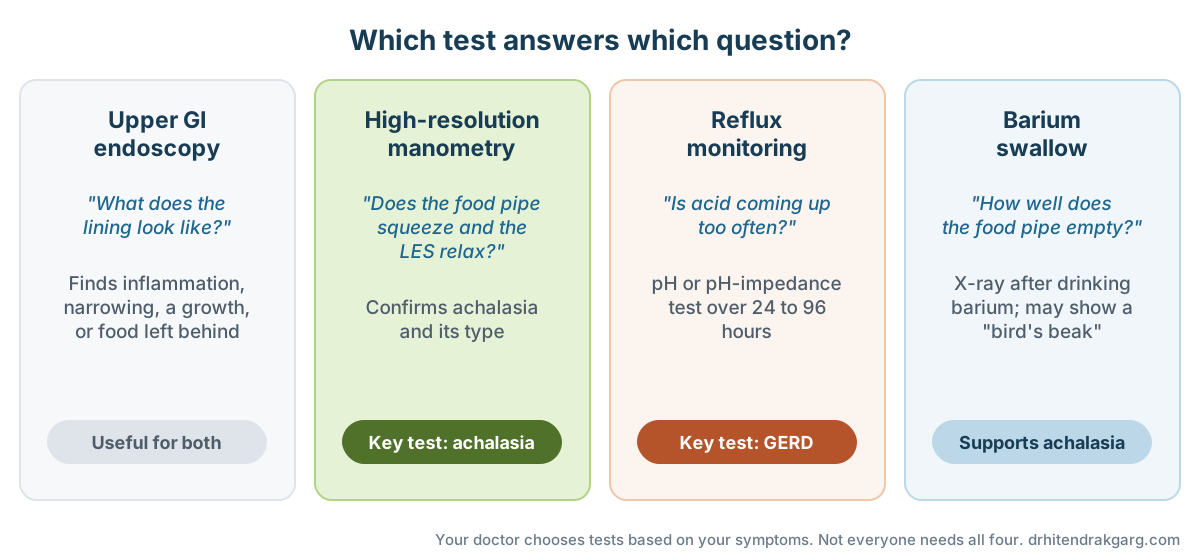
Upper GI endoscopy
A thin camera tube is passed through the mouth. It can show inflammation from reflux, a narrowing, a growth, or food left in the food pipe. It is often normal in both GERD and early achalasia, so it cannot settle the question on its own.
High-resolution manometry
A thin tube through the nose measures how the food pipe squeezes and whether the LES relaxes when you swallow. This is the key test that confirms achalasia and shows its type.
Barium swallow
X-rays taken after drinking barium show how the food pipe empties. In achalasia, it empties slowly and the lower end can look like a bird's beak.
Reflux monitoring
A small probe or capsule measures how often acid comes up, usually over 24 to 96 hours. The ACG GERD guideline advises reflux monitoring off acid medicine when the diagnosis is unclear, before long-term treatment or surgery (Katz and colleagues, American Journal of Gastroenterology, 2022).
Achalasia treatment vs GERD treatment
The two conditions are treated in opposite ways. Achalasia treatment loosens a valve that is too tight. GERD treatment reduces acid and helps a loose valve work better.
Treating achalasia
- POEM (peroral endoscopic myotomy): the tight muscle is cut from inside the food pipe, through the mouth, with no skin cuts. Read the full guide to POEM for achalasia.
- Laparoscopic Heller myotomy: keyhole surgery that cuts the muscle from outside, usually with a partial wrap to limit reflux.
- Pneumatic balloon dilation: a balloon stretches the LES; some people need repeat sessions.
- Botox injection: relaxes the LES for a few months; mainly for people not fit for the other options.
Treating GERD
- Lifestyle changes: smaller meals, no food for two to three hours before bed, raising the head end of the bed, and weight loss if needed.
- Acid-reducing medicines: such as proton pump inhibitors (PPIs), taken as advised by your doctor.
- Anti-reflux procedures: considered for some people after full testing.
GERD medicines lower acid, but they cannot open a tight LES. Achalasia treatments are not a replacement for GERD care either. Don't stop your prescribed medicines without talking to your doctor.
Can achalasia treatment cause GERD?
Yes. Loosening the LES lets food through, but it can also let acid come back up. Reflux is more common after POEM than after Heller myotomy, because Heller surgery usually includes an anti-reflux wrap.
In a review of 17 POEM studies (1,542 patients), 19% had reflux symptoms and 29% had reflux inflammation on endoscopy after POEM. After Heller myotomy with a wrap, the figures were 8.8% and 7.6% (Repici and colleagues, Gastrointestinal Endoscopy, 2018). Reflux after POEM is usually controlled with medicines. Because it can happen without heartburn, a follow-up endoscopy is often advised.
Achalasia and GERD: myths and facts
Mix-ups between these two conditions are common. Here is what is true.
| Myth | Fact |
|---|---|
| Heartburn always means GERD. | Burning can also come from food held in the food pipe in achalasia, and from other conditions. Symptoms that keep coming back need checking. |
| If acid medicines do not work, it must be achalasia. | GERD can also persist despite medicines, and other conditions can look similar. Tests decide. |
| Achalasia is just a bad case of acidity. | Achalasia is a nerve and muscle problem. Acid medicines cannot open the tight LES. |
| Some difficulty swallowing is normal with acidity. | Difficulty swallowing is a warning sign in both conditions and should always be checked. |
| A normal endoscopy rules out both. | Endoscopy is often normal in GERD and in early achalasia. Manometry or reflux monitoring may be needed. |
| Treating achalasia also treats reflux. | Achalasia treatments loosen the LES and can cause reflux, so follow-up checks for it. |
When should you see a gastroenterologist?
See a gastroenterologist if swallowing is difficult, food keeps coming back up, you are losing weight, or acidity continues despite treatment. These signs need tests, not just more antacids. Also read when daily acidity needs attention, and about H. pylori, another common cause of stomach symptoms.
Get urgent medical help if food is completely stuck and you cannot swallow your own saliva. Also seek emergency care for new or severe chest pain, especially with breathlessness, sweating, faintness, or pain spreading to the arm or jaw. Do not assume chest pain is reflux.
Frequently asked questions
Can GERD cause difficulty swallowing?
Yes. Long-standing GERD can inflame or narrow the food pipe, which makes solid food stick. Difficulty swallowing is a warning sign and should be checked with an endoscopy, not treated as simple acidity.
Does achalasia cause heartburn?
Some people with achalasia feel a burning chest. It often comes from food sitting in the food pipe, not from stomach acid. So acid medicines may not help much.
Can you have achalasia and GERD at the same time?
It is uncommon before treatment, because the tight valve in achalasia usually blocks reflux. Reflux is common after achalasia treatment, though, because the valve is loosened. Your doctor will check for it at follow-up.
Do acid-reducing medicines help achalasia?
They do not treat achalasia, because the problem is a tight muscle, not too much acid. They are often needed after POEM or other treatments to control reflux.
Is achalasia more serious than GERD?
Both need proper care. Untreated achalasia can cause weight loss, poor nutrition and chest infections from food going into the lungs. Untreated GERD can cause inflammation, narrowing of the food pipe and Barrett's oesophagus. Read about achalasia cardia and its treatment.
Which doctor should I see for swallowing problems?
A gastroenterologist. They can arrange an endoscopy, manometry and other tests to find the cause, and explain the treatment options.

References
- Vaezi MF, Pandolfino JE, Yadlapati RH, Greer KB, Kavitt RT. ACG Clinical Guidelines: Diagnosis and Management of Achalasia. Am J Gastroenterol. 2020;115(9):1393-1411. Source
- Katz PO, Dunbar KB, Schnoll-Sussman FH, Greer KB, Yadlapati R, Spechler SJ. ACG Clinical Guideline for the Diagnosis and Management of Gastroesophageal Reflux Disease. Am J Gastroenterol. 2022;117(1):27-56. Source
- Bhatia SJ, Reddy DN, Ghoshal UC, et al. Epidemiology and symptom profile of gastroesophageal reflux in the Indian population: report of the Indian Society of Gastroenterology Task Force. Indian J Gastroenterol. 2011;30(3):118-127. Source
- Eusebi LH, Ratnakumaran R, Yuan Y, Solaymani-Dodaran M, Bazzoli F, Ford AC. Global prevalence of, and risk factors for, gastro-oesophageal reflux symptoms: a meta-analysis. Gut. 2018;67(3):430-440. Source
- Sadowski DC, Ackah F, Jiang B, Svenson LW. Achalasia: incidence, prevalence and survival. A population-based study. Neurogastroenterol Motil. 2010;22(9):e256-261. Source
- Repici A, Fuccio L, Maselli R, et al. GERD after per-oral endoscopic myotomy as compared with Heller's myotomy with fundoplication: a systematic review with meta-analysis. Gastrointest Endosc. 2018;87(4):934-943. Source
Medical disclaimer: This article is for general education and is not a substitute for a consultation. Please see a doctor for advice about your own symptoms. Read our editorial policy.