POEM vs Heller Myotomy vs Balloon Dilation: Which Suits Whom?
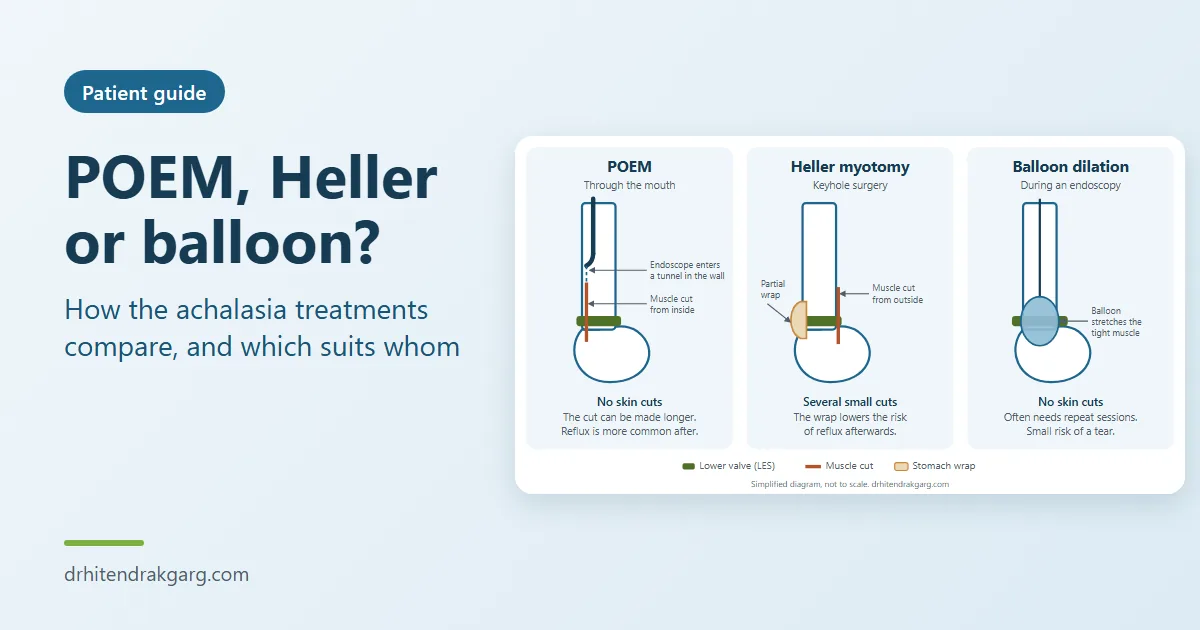
POEM, Heller myotomy and balloon dilation all treat achalasia by loosening the tight valve at the bottom of the food pipe. They differ in how they are done, how long they last and how often reflux follows.
In short
For achalasia types I and II, POEM, laparoscopic Heller myotomy and balloon (pneumatic) dilation give similar relief for most people. For type III, POEM or a tailored Heller myotomy is preferred. POEM leaves no skin cuts but causes reflux more often. Heller myotomy usually adds a stomach wrap that lowers reflux. Balloon dilation often needs repeat sessions.
When achalasia is confirmed, most people hear three names: POEM, Heller myotomy and balloon dilation. All three are proven treatments, and each has trade-offs. This guide puts them side by side, using the main trials, and explains what doctors weigh when they suggest one. If you are new to the condition, start with achalasia cardia: symptoms, causes and types.
Heller myotomy vs POEM vs balloon dilation: what is the difference?
All three loosen the tight valve at the bottom of the food pipe (the lower oesophageal sphincter, or LES). POEM and Heller myotomy cut the muscle. POEM works from inside, through the mouth. Heller myotomy works from outside, by keyhole surgery. Balloon dilation stretches the muscle without cutting it.
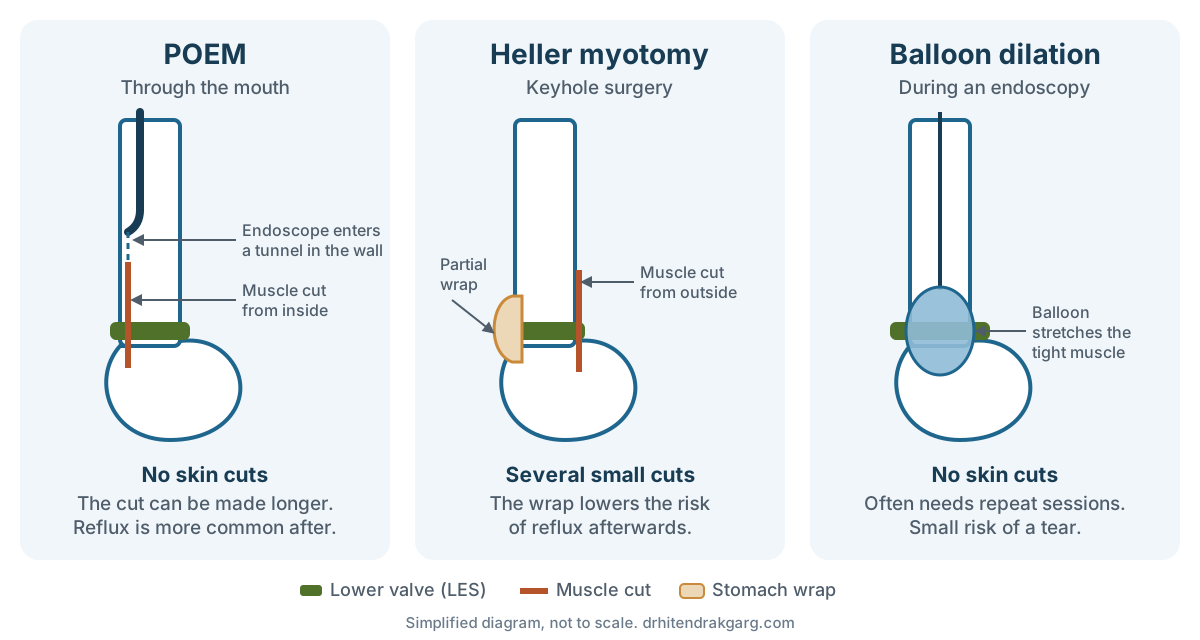
None of these treatments brings back the lost nerve cells that cause achalasia. The aim is to open the valve enough for food and drink to pass into the stomach. Opening the valve also makes it easier for acid to flow back up. That is why reflux is the main trade-off in every comparison below.
Achalasia treatment options compared
| POEM | Heller myotomy | Balloon dilation | |
|---|---|---|---|
| How it is done | Endoscope through the mouth; muscle cut from a tunnel inside the wall | Keyhole surgery; muscle cut from outside | Balloon inflated in the valve during an endoscopy |
| Anaesthesia | General | General | Usually sedation |
| Skin cuts | None | Several small cuts | None |
| Anti-reflux wrap | No | Usually yes (partial wrap) | No |
| Length of the cut | Can be made long, to cover spasm in type III | Shorter, unless tailored | No cut |
| Sessions | Usually one | Usually one | Often more than one over the years |
| Success at 2 years in trials | 83% to 92% | 82% to 90% | 54% to 86% |
| Reflux damage seen at 2 years | 41% to 44% | 29% | 7% |
| Main risks | Reflux; rarely bleeding, a tear in the lining or an air leak | Risks of surgery; a tear in the lining, usually repaired during the operation | A tear in the food pipe; symptoms returning |
The trial figures come from three different studies, described below. The patients and the way success was measured differ between them, so read the numbers as a guide, not an exact ranking.
How does POEM work?
POEM (peroral endoscopic myotomy) cuts the tight valve muscle from inside the food pipe. It is done through the mouth under general anaesthesia, so there are no cuts on the skin.
The doctor passes an endoscope (a thin, flexible camera) into the food pipe. A small opening is made in the inner lining. The endoscope then makes a tunnel inside the wall, down to the stomach. Through this tunnel, the inner muscle layer of the valve is cut. The opening in the lining is closed with small clips.
Because the doctor controls how far the tunnel goes, the cut can be made longer than in surgery. This helps in type III achalasia, where the spasm reaches higher up the food pipe. POEM can also be used when an earlier treatment has stopped working.
The main downside is reflux. POEM does not include a stomach wrap, so acid flows back more easily afterwards. POEM is also a technically demanding procedure, so the team's experience matters. Read the full guide to POEM for achalasia, including preparation, recovery and risks.
How does laparoscopic Heller myotomy work?
Heller myotomy is keyhole surgery that cuts the tight valve muscle from the outside. A surgeon does it under general anaesthesia, through several small cuts in the abdomen.
The surgeon cuts the muscle of the valve and carries the cut a short way onto the stomach. In most cases, a partial wrap of the upper stomach around the food pipe is added. This is called a partial fundoplication (Dor or Toupet). The wrap acts as a soft barrier against reflux.
Heller myotomy has been used for decades, so it has the longest record of the three. If you also have a hiatus hernia, the surgeon can usually repair it in the same operation. The downsides are the skin cuts and a longer recovery than with an endoscopic treatment. For type III achalasia, the surgeon needs to extend, or "tailor", the cut to cover the spastic part.
How does pneumatic (balloon) dilation work?
Pneumatic dilation stretches the tight valve with a balloon. It is done during an endoscopy, usually under sedation, and there is no cut in the skin or the food pipe wall.
The doctor places a special balloon across the valve and inflates it for a short time. This stretches and tears some of the tight muscle fibres, so the valve opens more easily. The first session usually uses a smaller balloon. A larger one is used later if needed. This step-by-step approach is called graded dilation.
Recovery is quick, and reflux is less common than after POEM. But the effect often fades over time, and many people need more sessions. The main risk is a tear (perforation) in the food pipe. Because a tear may need surgery to repair, balloon dilation is usually offered to people who would be fit for surgery. Younger people tend to do less well after balloon dilation (Eckardt and colleagues, Gastroenterology, 1992).
What did the main trials find?
Three large randomised trials have compared these treatments head to head. POEM did as well as Heller surgery. Heller surgery did as well as balloon dilation. POEM did better than two planned balloon dilations. In each trial, reflux was more common after POEM.
POEM vs Heller myotomy
A European trial assigned 221 people to POEM or Heller myotomy with a partial wrap. At two years, symptoms were well controlled in 83% after POEM and 82% after surgery. Serious complications happened in 2.7% after POEM and 7.3% after surgery. Reflux damage on endoscopy was seen in 44% after POEM and 29% after surgery (Werner and colleagues, New England Journal of Medicine, 2019).
POEM vs balloon dilation
A trial at six hospitals in Europe, Asia and the United States assigned 133 newly diagnosed people to POEM or to two planned balloon dilations. At two years, treatment had worked without needing more treatment in 92% after POEM and 54% after balloon dilation. Reflux damage was seen in 41% after POEM and 7% after dilation (Ponds and colleagues, JAMA, 2019).
Heller myotomy vs balloon dilation
The European Achalasia Trial assigned 201 people to Heller myotomy or balloon dilation. In that trial, repeat dilations were allowed. At two years, treatment was working in 90% after surgery and 86% after dilation, and the trial found no real difference between them. A tear of the food pipe happened in 4% of people during dilation (Boeckxstaens and colleagues, New England Journal of Medicine, 2011).
Why do the balloon results differ so much? In the European trial, people could have more dilations when symptoms came back. In the POEM trial, needing more treatment after two dilations counted as failure.
Does the type of achalasia change the result?
Yes. Using data from the European trial, researchers looked at results by achalasia type. Treatment worked in 96% of people with type II, 81% with type I and 66% with type III. In type III, Heller myotomy worked in 86% and balloon dilation in 40%, although this group was small (Rohof and colleagues, Gastroenterology, 2013).
Which achalasia treatment suits whom?
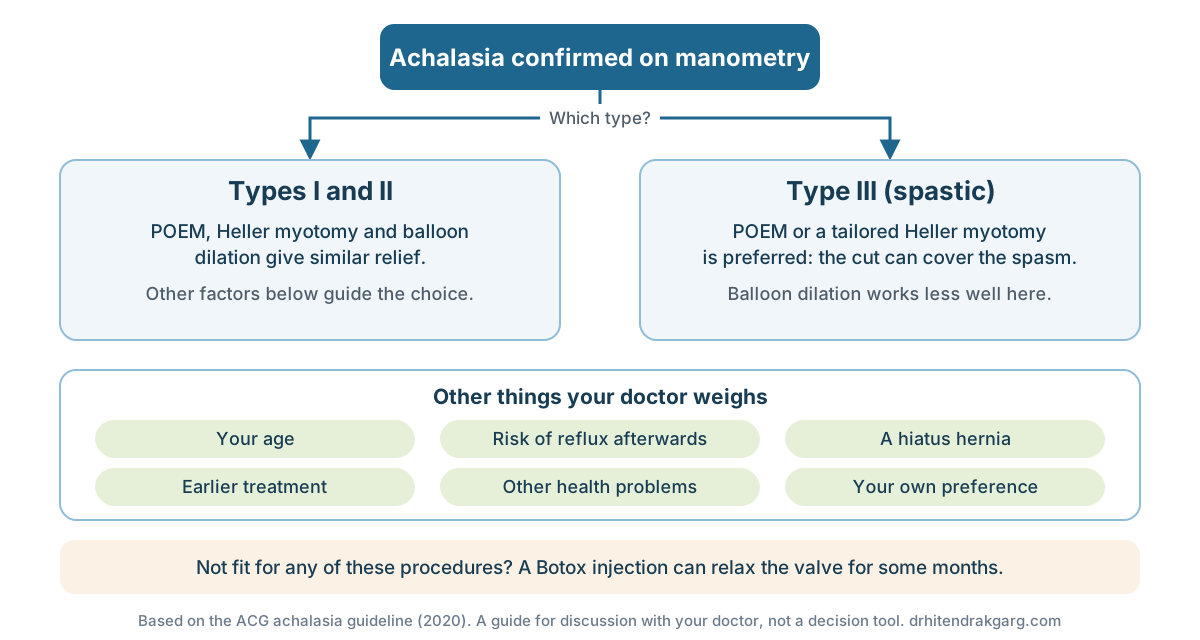
No single treatment is right for everyone. The choice depends mainly on your achalasia type, then on your age, health, reflux risk, any earlier treatment and your own wishes. The American College of Gastroenterology guideline sets out how these fit together (ACG achalasia guideline, 2020).
Types I and II
The ACG guideline finds that POEM, Heller myotomy and balloon dilation give similar relief in types I and II. So the other factors below decide the choice.
Type III (spastic achalasia)
The guideline prefers POEM or a tailored Heller myotomy over balloon dilation for type III. A long cut can cover the whole spastic part of the food pipe, which a balloon cannot reach.
Younger adults
Balloon dilation tends to work less well in younger people, and the effect may fade sooner. Many doctors lean towards POEM or Heller myotomy for them.
If reflux is a big concern
Heller myotomy with a wrap, or balloon dilation, leads to less reflux than POEM. Reflux after POEM is usually controlled with acid-reducing medicines, but some people need them long term.
If you have a hiatus hernia
A hiatus hernia is when part of the stomach slides up into the chest. Surgery can repair it at the same time as the Heller myotomy. POEM and balloon dilation do not fix it.
If an earlier treatment has stopped working
Symptoms can return months or years after any of these treatments. Options then include a repeat balloon dilation, POEM, or further surgery. Your doctor will look at what was done before and why it stopped working.
If you are not fit for any of these procedures
For people who are too frail or unwell, a Botox injection into the valve is an option. It is simple, but its effect wears off. In one trial, 32% of people were still well a year after Botox, compared with 70% after balloon dilation (Vaezi and colleagues, Gut, 1999).
What happens after each treatment?
After any of the three, most people swallow much better within days. Follow-up continues for years, because symptoms or reflux can appear later. Recovery is usually quicker after POEM and balloon dilation, because there are no wounds in the abdomen.
Most people start with liquids and move to soft food over the following days, as their team advises. Softer foods help in the early days; see these easily digestible Indian foods. Your doctor may repeat the symptom score, a barium swallow or an endoscopy to check how well the food pipe is emptying.
Reflux needs special attention after POEM. A review of 45 studies found reflux symptoms in 19% of people after POEM and 8.8% after Heller myotomy with a wrap. Damage from reflux on endoscopy was seen in 29% and 7.6% (Repici and colleagues, Gastrointestinal Endoscopy, 2018). Reflux after achalasia treatment can be silent, so a check-up endoscopy is often advised even without heartburn. Read more on GERD symptoms and treatment and how achalasia differs from GERD.
If you are given acid-reducing medicines after treatment, take them as advised. Don't stop your prescribed medicines without talking to your doctor.
Questions to ask before you choose
A good choice comes from a clear talk with your gastroenterologist. These questions can help you prepare.
- Which type of achalasia do I have, and how does that change my options?
- Which treatments are suitable for me, and why?
- What are the main risks of each, and how often do they happen in your team's experience?
- How likely is reflux afterwards, and how will it be checked and managed?
- What follow-up tests will I need, and how often?
- What happens if symptoms come back?
Bring your manometry, endoscopy and barium swallow reports, and a list of your medicines.
Achalasia treatments: myths and facts
There is a lot of confusion about these treatments. Here are common myths, and what the evidence shows.
| Myth | Fact |
|---|---|
| POEM is too new to trust. | POEM has been compared with Heller surgery and balloon dilation in large randomised trials, with similar or better symptom control at two years. |
| No skin cuts means no risks. | POEM is done under general anaesthesia and has risks, including reflux, bleeding and air leaks. |
| Balloon dilation is just a test. | It is a treatment, with a small risk of a tear in the food pipe (4% in one trial). |
| Heller myotomy means opening the chest. | It is usually keyhole surgery through small cuts in the abdomen. |
| After treatment, achalasia is gone for good. | The nerve damage stays. Symptoms can return, and some people need more treatment. |
| Reflux after POEM means it failed. | Reflux is a known effect of opening the valve. It is usually controlled with medicine and does not mean the treatment failed. |
When should you see a gastroenterologist?
See a gastroenterologist if swallowing has been hard for more than a few weeks, if food keeps coming back up, or if you are losing weight without trying. If you have already been treated, get checked when swallowing gets harder again or reflux starts.
Also get checked if "acidity" does not improve with acid medicines. Read when daily acidity needs attention.
Get urgent medical help if food is completely stuck and you cannot swallow your own saliva, or if you have severe chest pain, fever or trouble breathing after a procedure.
Frequently asked questions
Is POEM better than Heller myotomy?
Neither is better for everyone. In the largest trial, symptoms were well controlled at two years in 83% after POEM and 82% after Heller myotomy. POEM avoids skin cuts and allows a longer cut, which helps in type III achalasia. Heller myotomy usually adds a wrap, so reflux is less common afterwards.
What is the difference between Heller myotomy and POEM?
Both cut the tight valve muscle. Heller myotomy is keyhole surgery that cuts it from outside, usually with a partial stomach wrap against reflux. POEM is done through the mouth with an endoscope and cuts the muscle from a tunnel inside the food pipe wall, with no skin cuts and no wrap.
Is pneumatic dilation for achalasia safe?
It is an established treatment, but it carries a small risk of a tear in the food pipe. In the European Achalasia Trial, this happened in 4% of people. It should be done by an experienced team, and it is usually offered to people who would be fit for surgery if a tear needed repair.
Which achalasia treatment lasts the longest?
A myotomy, either POEM or Heller, usually lasts longer than a single balloon dilation, which often needs repeating. Heller myotomy has the longest record, going back decades. Symptoms can return after any treatment, so follow-up continues for years.
Can POEM be done after a failed Heller myotomy or balloon dilation?
Often, yes. Because POEM works from inside the food pipe, it can avoid the scarred area from earlier surgery. Your doctor will review your earlier treatment and test results before advising on the next step.
How quickly can I get back to normal after each treatment?
Recovery is usually quicker after POEM and balloon dilation than after Heller surgery, because there are no wounds in the abdomen. Most people move from liquids to soft food over several days. Your team will give you a plan for eating, work and follow-up.

References
- Vaezi MF, Pandolfino JE, Yadlapati RH, Greer KB, Kavitt RT. ACG Clinical Guidelines: Diagnosis and Management of Achalasia. Am J Gastroenterol. 2020;115(9):1393-1411. Source
- Werner YB, Hakanson B, Martinek J, et al. Endoscopic or Surgical Myotomy in Patients with Idiopathic Achalasia. N Engl J Med. 2019;381(23):2219-2229. Source
- Ponds FA, Fockens P, Lei A, et al. Effect of Peroral Endoscopic Myotomy vs Pneumatic Dilation on Symptom Severity and Treatment Outcomes Among Treatment-Naive Patients With Achalasia: A Randomized Clinical Trial. JAMA. 2019;322(2):134-144. Source
- Boeckxstaens GE, Annese V, des Varannes SB, et al. Pneumatic dilation versus laparoscopic Heller's myotomy for idiopathic achalasia. N Engl J Med. 2011;364(19):1807-1816. Source
- Rohof WO, Salvador R, Annese V, et al. Outcomes of treatment for achalasia depend on manometric subtype. Gastroenterology. 2013;144(4):718-725. Source
- Eckardt VF, Aignherr C, Bernhard G. Predictors of outcome in patients with achalasia treated by pneumatic dilation. Gastroenterology. 1992;103(6):1732-1738. Source
- Vaezi MF, Richter JE, Wilcox CM, et al. Botulinum toxin versus pneumatic dilatation in the treatment of achalasia: a randomised trial. Gut. 1999;44(2):231-239. Source
- Repici A, Fuccio L, Maselli R, et al. GERD after per-oral endoscopic myotomy as compared with Heller's myotomy with fundoplication: a systematic review with meta-analysis. Gastrointest Endosc. 2018;87(4):934-943. Source
Medical disclaimer: This article is for general education and is not a substitute for a consultation. Please see a doctor for advice about your own symptoms. Read our editorial policy.