Reflux After POEM: How Common It Is and How It Is Managed
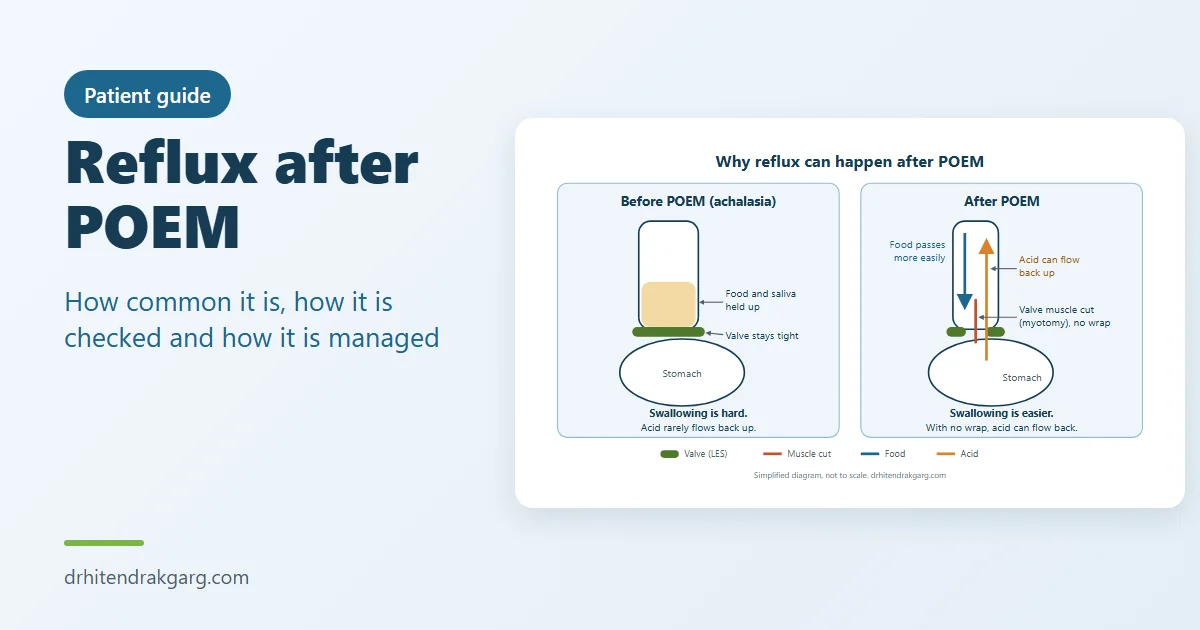
POEM opens the tight valve at the bottom of the food pipe so food can pass. The same opening lets stomach acid flow back up more easily. This guide explains how often that happens, how it is found and how it is managed.
In short
Reflux (GERD) is the most common side effect of POEM for achalasia. In a review of 17 studies, about 1 in 5 people had reflux symptoms after POEM, and about 3 in 10 had reflux damage on endoscopy. Reflux after POEM is often silent, so a check-up endoscopy is usually advised. Most reflux damage seen after POEM is mild. It is usually managed with acid-reducing medicines (PPIs) and simple daily habits. A few people need an anti-reflux procedure.
If you have had POEM, or are planning it, you have probably heard that reflux can follow. It is the main trade-off of the procedure. This guide explains why it happens, how common it is, what to look out for, and how doctors check and treat it. If you are still choosing a treatment, start with the guide to POEM for achalasia.
Why does reflux happen after POEM?
Reflux happens after POEM because the procedure loosens the valve that normally keeps stomach acid down. POEM relieves the blockage of achalasia by cutting this tight muscle, so the barrier against acid becomes weaker.
The valve is called the lower oesophageal sphincter (LES). In achalasia cardia, it stays tight and does not relax when you swallow. Food and saliva get held up in the food pipe. POEM cuts the inner muscle of this valve from inside, through the mouth, so food can pass into the stomach again.
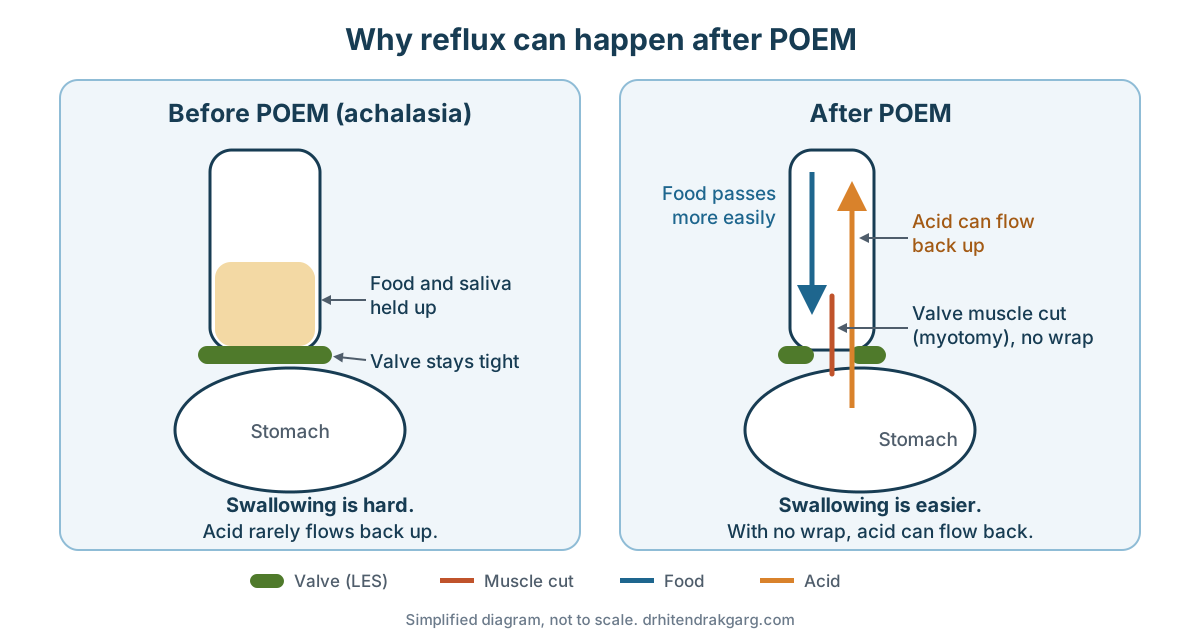
Heller myotomy, the keyhole surgery for achalasia, cuts the same muscle. But the surgeon usually adds a partial wrap of the stomach around the bottom of the food pipe. The wrap acts as a soft barrier against acid. Standard POEM does not add this wrap. That is the main reason reflux is more common after POEM. The American College of Gastroenterology (ACG) notes that reflux is more common after POEM than after Heller surgery with a wrap or balloon dilation (ACG achalasia guideline, 2020).
There is a second reason. In achalasia, the food pipe squeezes weakly or not at all, and POEM does not change that. So acid that comes up can stay in the food pipe longer before it is cleared.
How common is reflux after POEM?
Reflux after POEM is common. Depending on how it is measured, studies find it in about 1 in 5 people to more than half. Heartburn is less common than reflux found on tests.
The largest review combined 17 POEM studies with 1,542 people. It found reflux symptoms in 19%, too much acid on a pH test in 39%, and reflux damage on endoscopy in 29% (Repici and colleagues, Gastrointestinal Endoscopy, 2018).
A study at seven hospitals in Asia, Europe and the United States tested 282 people about a year after POEM. A pH test showed too much acid in 58% of them (Kumbhari and colleagues, Endoscopy, 2017).
Why do the numbers differ? Each method finds something different. Symptoms depend on how you feel. Endoscopy shows damage to the lining. A pH test measures acid directly, so it picks up the most cases.
Reflux after POEM vs Heller myotomy vs balloon dilation
Reflux is more common after POEM than after the other two main achalasia treatments. Here is what the main studies found.
| What was measured | POEM | Heller myotomy with wrap | Balloon dilation |
|---|---|---|---|
| Anti-reflux wrap added | No | Usually yes | No |
| Reflux symptoms (review of 45 studies) | 19% | 8.8% | Not in this review |
| Too much acid on a pH test (same review) | 39% | 16.8% | Not in this review |
| Reflux damage on endoscopy (same review) | 29% | 7.6% | Not in this review |
| Reflux damage on endoscopy at 2 years (trials) | 41% to 44% | 29% | 7% |
The review is by Repici and colleagues (2018). The trial figures come from a European trial of POEM vs Heller myotomy (Werner and colleagues, New England Journal of Medicine, 2019) and an international trial of POEM vs balloon dilation (Ponds and colleagues, JAMA, 2019). The studies used different patients and methods, so read the figures as a guide. For how the three treatments compare on swallowing relief, see POEM vs Heller myotomy vs balloon dilation.
Does reflux after POEM change over time?
In the European trial, reflux damage was seen in 57% of people 3 months after POEM and in 44% at 2 years (Werner and colleagues, 2019). A review of 11 long-term studies followed 2,342 people for a median of 4 years. It found reflux symptoms in 22%, and this rate stayed stable over time (Vespa and colleagues, Endoscopy, 2023).
What are the symptoms of reflux after POEM?
The main symptoms are heartburn, which is a burning feeling behind the breastbone, and a sour or bitter taste as stomach fluid comes up. But many people with reflux after POEM have no symptoms at all.
- Heartburn or burning in the chest, often after meals or when lying down
- Sour or bitter fluid coming up into the throat or mouth
- A cough, hoarse voice or frequent throat clearing, often at night
- Pain or discomfort in the upper stomach or chest
- Waking at night with burning or coughing
Silent reflux after POEM
Silent reflux means acid comes up without causing heartburn. In the seven-hospital study, 60% of people who had too much acid on a pH test had no reflux symptoms (Kumbhari and colleagues, 2017). This is why a check-up endoscopy is often advised even when you feel well.
Is it reflux, or is achalasia coming back?
Both can cause chest discomfort and fluid coming up, so they are easy to mix up. The table shows the usual differences. Your doctor will confirm which it is with tests.
| Clue | More likely reflux | More likely achalasia returning |
|---|---|---|
| Main feeling | Burning behind the breastbone | Food or drink sticking in the chest |
| What comes up | Sour or bitter fluid | Undigested food or saliva, not sour |
| Swallowing | Usually normal | Getting harder again |
| Weight | Usually steady | May fall |
| Acid-reducing medicine | Often helps | Makes little difference |
Long-standing reflux can also narrow the food pipe and make swallowing harder, so tell your doctor about any change. For more on how the two conditions differ, read achalasia vs GERD.
Who is more likely to get reflux after POEM?
Anyone can get reflux after POEM, and doctors cannot yet predict exactly who will. Studies have found a few factors linked to higher or lower rates.
- Women: in the seven-hospital study, women were more likely to have reflux on a pH test. No detail of how the procedure was done predicted reflux (Kumbhari and colleagues, 2017).
- Higher body weight: a study from Amsterdam followed people for more than 5 years after POEM. A higher body mass index (BMI) was linked to more severe reflux damage (Wessels and colleagues, Diseases of the Esophagus, 2026).
- Earlier treatment: in the same study, people who had Heller surgery before POEM, or a balloon dilation after it, had lower rates of reflux damage.
If reflux worries you, raise it before you choose a treatment. Your doctor can explain how your own risk compares across the options.
How is reflux checked after POEM?
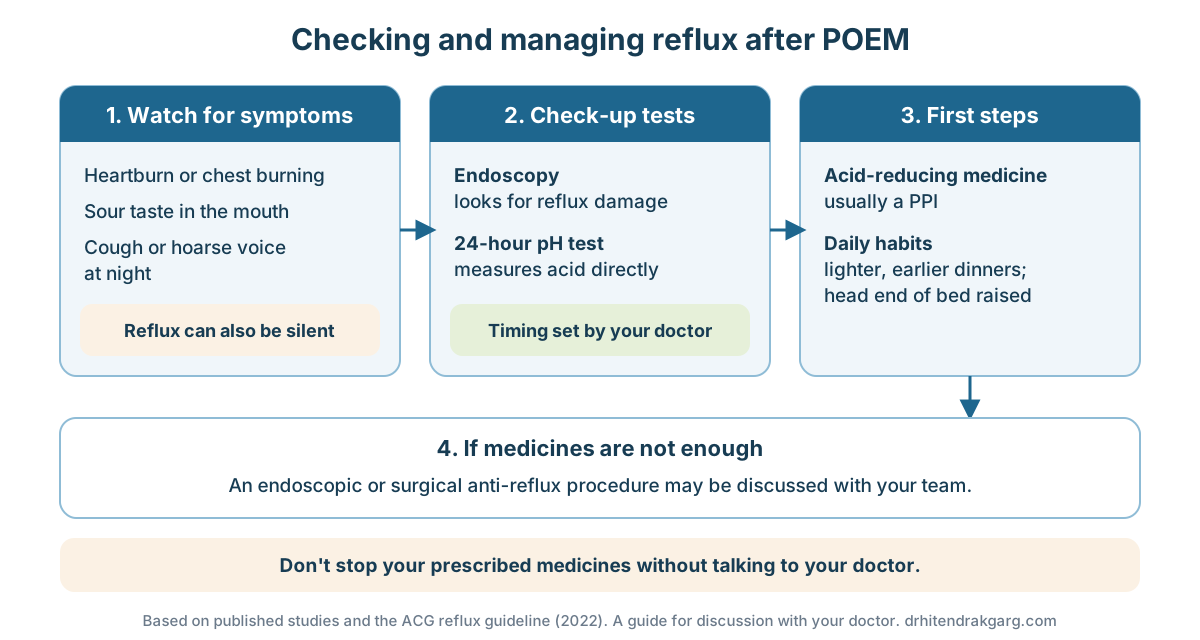
Reflux after POEM is checked mainly with an upper GI endoscopy, sometimes with a pH test. Your doctor sets the timing. Many teams plan a check within the first year and then as needed.
- Upper GI endoscopy: a thin, flexible camera is passed through the mouth to look at the lining of the food pipe. Acid can cause redness or small breaks in the lining (oesophagitis). Doctors grade this damage from A (mild) to D (severe), using the Los Angeles grades. The same test looks for Barrett's oesophagus and narrowing.
- 24-hour pH test: a thin tube through the nose, or a small capsule attached to the lining, measures acid in the food pipe over a day or more. It shows how much of the time acid is present. Your doctor will tell you whether to pause any medicine before the test.
- Symptom review: at each visit, your doctor asks about heartburn and swallowing. A symptom score for achalasia (the Eckardt score) shows whether POEM is still working.
Because reflux can be silent, keep your follow-up visits even if you feel well.
How is reflux after POEM treated?
Most reflux after POEM is treated with acid-reducing medicines called proton pump inhibitors (PPIs), along with simple changes to daily habits. A small number of people need a procedure to strengthen the barrier against acid.
Acid-reducing medicines (PPIs)
PPIs lower the amount of acid the stomach makes. Common examples are omeprazole, pantoprazole, rabeprazole and esomeprazole. They are the main medicine for reflux in the ACG reflux guideline (ACG GERD guideline, 2022). In the seven-hospital study, most reflux damage found after POEM was mild, at Los Angeles grade A or B (Kumbhari and colleagues, 2017).
Some people need a PPI only for a while. Others need it for years. Your doctor will set the dose and how long to take it, based on your symptoms and endoscopy. PPIs work better when taken 30 to 60 minutes before a meal, unless your doctor advises otherwise.
Don't stop your prescribed medicines without talking to your doctor. Reflux damage can come back without any symptoms.
Daily habits that help
Habits that reduce reflux in general can also help after POEM. The ACG reflux guideline suggests these steps.
- Lose weight if you are overweight.
- Finish your last meal 2 to 3 hours before you lie down. In many Indian homes, dinner is late, so moving it earlier can help.
- Raise the head end of your bed if you have symptoms at night. Blocks under the bed legs work better than extra pillows.
- Avoid foods that set off your symptoms. Common triggers include fried or spicy food, very large meals, tea, coffee and fizzy drinks.
- Stop smoking and avoid all tobacco.
Eating slowly and chewing well also helps the food pipe empty after POEM. Soft, easily digestible Indian foods are a good choice in the early weeks. Read more about GERD symptoms and treatment.
When medicines are not enough
If reflux is severe or does not settle with medicines, other options may be discussed. These are needed less often, and the choice depends on your tests and your team.
- Endoscopic plication: done through the mouth, this folds and staples the top of the stomach to tighten the junction with the food pipe. A trial at a Mumbai hospital included 60 people who needed PPIs for reflux after POEM. Three months later, acid levels fell below the trial's target in 69% after plication, compared with 10% after a sham procedure. At 6 months, 28% were still taking PPIs, compared with 72% after the sham (Maydeo and colleagues, Endoscopy, 2023).
- Anti-reflux surgery: keyhole surgery to add a stomach wrap (fundoplication). It is usually considered only when other steps have not worked. The surgeon normally uses a partial wrap, because the food pipe in achalasia squeezes weakly.
Can reflux be prevented during POEM?
Some centres now add a stomach wrap during POEM itself, through the endoscope. This is called POEM with fundoplication (POEM-F). A review of 7 studies with 127 people found it controlled reflux in about 86%, with major complications in 3.6% (Gopakumar and colleagues, Endoscopy International Open, 2025). It adds time to the procedure, few centres offer it, and long-term results are still awaited. Ask your team whether it is available and suitable for you.
Can reflux after POEM cause long-term problems?
Reflux that goes on for years can damage the lining of the food pipe, so it needs follow-up. Serious problems seem uncommon, but studies beyond 5 years are still few.
The Amsterdam study checked 161 people at least 5 years after POEM. Reflux damage was found in 42%, and about a third of those cases were severe (grade C or D). Barrett's oesophagus, a change in the lining that needs regular checks, was found in 5 people (3.1%). Narrowing caused by acid (a peptic stricture) was found in 3 people (1.9%), and no cancers were found (Wessels and colleagues, 2026).
The long-term review of 2,342 people reported 3 cases of narrowing and 1 case of Barrett's oesophagus (Vespa and colleagues, 2023). This is why regular follow-up is advised after POEM, even when swallowing is good. Your doctor will decide how often you need an endoscopy.
Reflux after POEM: myths and facts
Reflux after POEM is often misunderstood. Here are common myths, and what the evidence shows.
| Myth | Fact |
|---|---|
| Reflux after POEM means the procedure failed. | Reflux is a known effect of opening the valve. POEM can still be working well for swallowing. |
| No heartburn means no reflux. | In one study, 60% of people with too much acid on testing had no reflux symptoms. |
| Everyone gets reflux after POEM. | Many people do not. In the largest review, 19% had reflux symptoms and 29% had damage on endoscopy. |
| Once reflux starts, I will need surgery. | Most people are managed with PPIs and daily habits. Procedures are for the few whose reflux does not settle. |
| I can stop my PPI once the heartburn goes. | Damage can come back without symptoms. Don't stop your prescribed medicines without talking to your doctor. |
| Reflux after POEM is the same as achalasia coming back. | They are different problems with different treatments. Tests can tell them apart. |
When should you see your doctor about reflux after POEM?
See your gastroenterologist if you have heartburn or sour fluid coming up most weeks, if acid medicine does not help, or if swallowing gets harder again. Also see your doctor if you are losing weight without trying.
Keep your planned follow-up endoscopy even if you feel well. If you have not had POEM and simply have frequent acidity, read when daily acidity needs attention.
Get urgent medical help if you vomit blood, pass black stools, have food completely stuck, or have severe chest pain or trouble breathing.
Frequently asked questions
Is reflux common after POEM?
Yes. In a review of 17 studies with 1,542 people, 19% had reflux symptoms after POEM, 39% had too much acid on a pH test and 29% had reflux damage on endoscopy. Reflux is more common after POEM than after Heller myotomy with a wrap, because POEM does not add a wrap.
How long does reflux last after POEM?
It varies. Some people need acid-reducing medicine only for a while, and others need it for years. A review of long-term studies found reflux symptoms in 22% of people a median of 4 years after POEM, a rate that stayed stable over time. Your doctor will review your need for treatment at follow-up.
Do I need to take PPIs forever after POEM?
Not everyone does. Your doctor decides the dose and length of treatment based on your symptoms and endoscopy results. Reflux damage can return without symptoms, so don't stop your prescribed medicines without talking to your doctor.
How is reflux after POEM diagnosed?
Mainly with an upper GI endoscopy, which shows any damage to the lining of the food pipe. A 24-hour pH test may be added to measure acid directly. Because reflux after POEM is often silent, these tests are useful even if you have no heartburn.
Can reflux after POEM be prevented?
Standard POEM does not add an anti-reflux wrap, so reflux cannot always be prevented. Some centres offer POEM with fundoplication (POEM-F), which adds a wrap during the procedure, but long-term results are still awaited. Healthy weight, early dinners and regular follow-up help find and manage reflux early.
What foods should I avoid for reflux after POEM?
Avoid the foods that set off your own symptoms. Common triggers include fried or spicy food, very large meals, tea, coffee and fizzy drinks. Finish dinner 2 to 3 hours before lying down, and eat slowly. Your doctor or dietitian can tailor this to you.
Is reflux after POEM dangerous?
Most reflux damage found after POEM is mild and is managed with medicines. Over many years, untreated reflux can cause severe damage, narrowing or Barrett's oesophagus. In a study of people followed for more than 5 years, Barrett's oesophagus was found in 3.1% and no cancers were found. Regular follow-up helps find these problems early.

References
- Repici A, Fuccio L, Maselli R, et al. GERD after per-oral endoscopic myotomy as compared with Heller's myotomy with fundoplication: a systematic review with meta-analysis. Gastrointest Endosc. 2018;87(4):934-943. Source
- Kumbhari V, Familiari P, Bjerregaard NC, et al. Gastroesophageal reflux after peroral endoscopic myotomy: a multicenter case-control study. Endoscopy. 2017;49(7):634-642. Source
- Werner YB, Hakanson B, Martinek J, et al. Endoscopic or Surgical Myotomy in Patients with Idiopathic Achalasia. N Engl J Med. 2019;381(23):2219-2229. Source
- Ponds FA, Fockens P, Lei A, et al. Effect of Peroral Endoscopic Myotomy vs Pneumatic Dilation on Symptom Severity and Treatment Outcomes Among Treatment-Naive Patients With Achalasia: A Randomized Clinical Trial. JAMA. 2019;322(2):134-144. Source
- Vespa E, Pellegatta G, Chandrasekar VT, et al. Long-term outcomes of peroral endoscopic myotomy for achalasia: a systematic review and meta-analysis. Endoscopy. 2023;55(2):167-175. Source
- Wessels EM, Masclee GMC, Bastiaansen BAJ, et al. Long-term outcomes of peroral endoscopic myotomy (POEM): reflux esophagitis and complications including Barrett esophagus and peptic strictures. Dis Esophagus. 2026;39(4):doag086. Source
- Maydeo AP, Patil GK, Kamat N, et al. Endoscopic full-thickness plication for the treatment of gastroesophageal reflux after peroral endoscopic myotomy: a randomized sham-controlled study. Endoscopy. 2023;55(8):689-698. Source
- Gopakumar H, Annor E, Vohra I, et al. Peroral endoscopic myotomy with fundoplication (POEM-F) for achalasia: systematic review and meta-analysis. Endosc Int Open. 2025;13:a25368132. Source
- Vaezi MF, Pandolfino JE, Yadlapati RH, Greer KB, Kavitt RT. ACG Clinical Guidelines: Diagnosis and Management of Achalasia. Am J Gastroenterol. 2020;115(9):1393-1411. Source
- Katz PO, Dunbar KB, Schnoll-Sussman FH, Greer KB, Yadlapati R, Spechler SJ. ACG Clinical Guideline for the Diagnosis and Management of Gastroesophageal Reflux Disease. Am J Gastroenterol. 2022;117(1):27-56. Source
Medical disclaimer: This article is for general education and is not a substitute for a consultation. Please see a doctor for advice about your own symptoms. Read our editorial policy.