Bloating: Common Causes and When to See a Doctor
A tight, full, swollen tummy is one of the most common gut complaints. Most of the time the cause is harmless and fixable. This guide explains the usual causes of bloating, what each one feels like, and which signs mean you should get checked.
In short
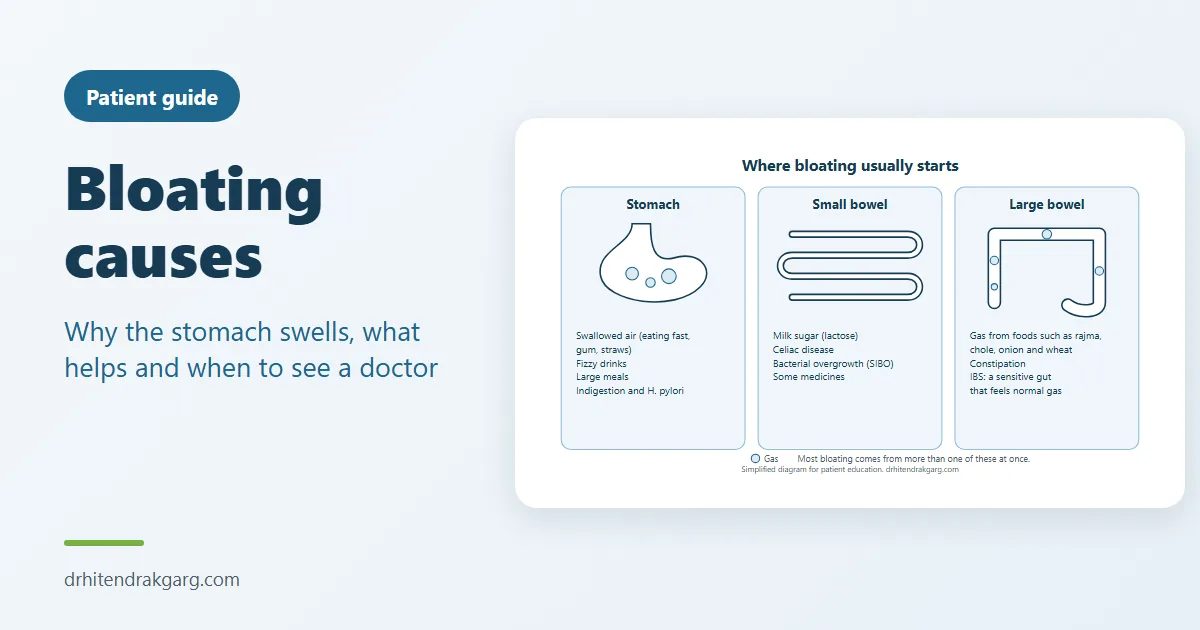
Bloating is a feeling of fullness or tightness in the tummy, sometimes with a visibly swollen belly. It is usually harmless. The most common causes are swallowed air and gas-forming foods such as rajma and chole. Constipation, irritable bowel syndrome (IBS) and trouble digesting milk are the other big ones. About 18% of adults worldwide have bloating every week. See a doctor if it is new and lasts more than a few weeks. Get checked sooner if it comes with weight loss or blood in the stool. Vomiting and fever are warning signs too, as is a swelling that never goes down.
Most people know the feeling. You finish lunch, and an hour later your waistband feels too tight. Some days it settles by evening. Other days it builds and builds until you want to loosen every button and lie down, which is not much help when you are at work. This guide looks at why that happens, what usually causes it, and when a swollen stomach needs a doctor rather than a change of diet.
What is bloating?
Bloating is the feeling that your tummy is full and tight, as if it has been stretched. Doctors separate it from distension, which is a belly that you can actually see getting bigger. The two often happen together, but not always.
Here is the surprise. Many people with bloating do not have more gas than anyone else. Their gut is more sensitive to normal amounts of gas. The nerves in the bowel wall send stronger signals to the brain, so ordinary stretching feels uncomfortable. This is called visceral hypersensitivity, and it is a big part of bloating in IBS.
Distension is different. In some people, the muscles of the belly wall relax and the diaphragm (the breathing muscle under the lungs) pushes down after a meal. The belly sticks out even though the amount of gas inside is normal. Doctors call this abdominophrenic dyssynergia. It explains why some people look six months pregnant by evening and flat again in the morning.
How common is stomach bloating?
Very common. Large surveys show that roughly 1 in 7 to 1 in 5 adults have stomach bloating in any given week.
The Rome Foundation surveyed more than 51,000 adults in 26 countries. Almost 18% said they had bloating at least once a week, with rates from 11% in East Asia to 20% in Latin America. Women reported it about twice as often as men (Ballou and colleagues, Gastroenterology, 2023).
A United States survey of 88,795 adults found that 13.9% had bloating in the past week. Of these, 58.5% had never seen a doctor about it (Oh and colleagues, Clinical Gastroenterology & Hepatology, 2023). So if you have put up with it quietly, you are far from alone.
Only a small share of people have bloating as their main problem with no other gut condition behind it. In the Rome Foundation data, this "functional bloating" affected about 3.5% of adults.
What are the common causes of bloating?
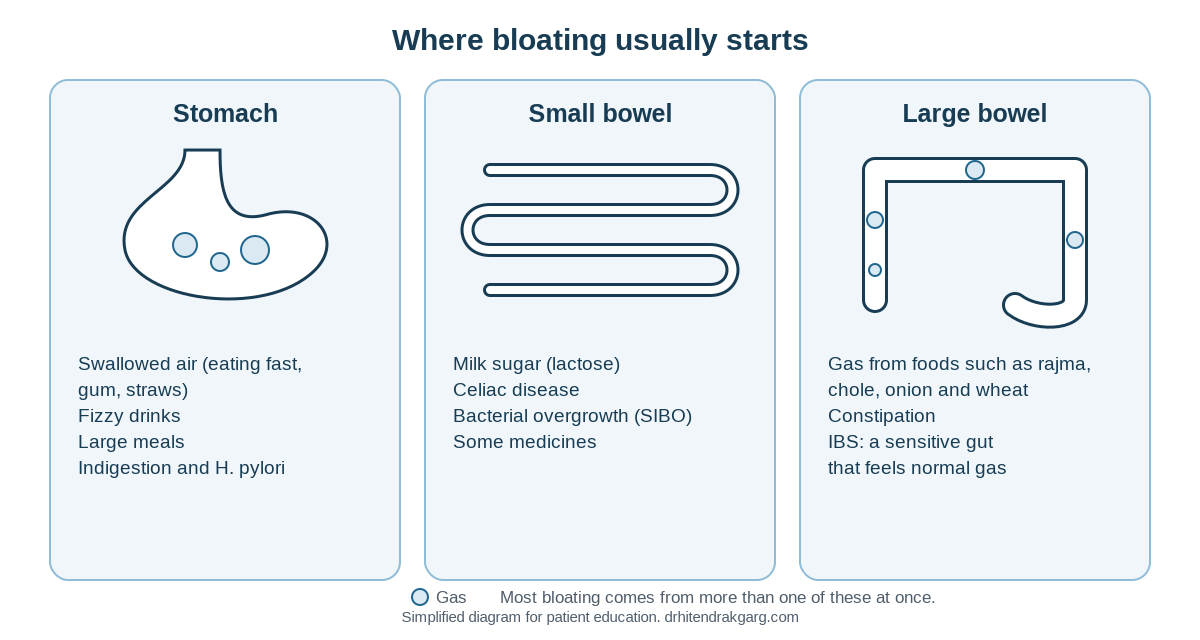
The common causes of bloating are swallowed air and foods that make gas. Constipation and IBS come next. Then there is poor digestion of milk sugar. Less often it is an infection or celiac disease, or a problem outside the gut altogether.
1. Swallowed air
Everyone swallows some air with food and drink. You swallow more when you eat fast or talk while eating. Chewing gum and drinking through a straw add to it, and so do cola and soda. Most of it comes back up as burps. The rest passes on into the bowel, where it adds to the feeling of fullness that some people notice for an hour or more after a rushed meal eaten at a desk or in a car.
2. Gas-forming foods
Some carbohydrates are not fully absorbed in the small bowel. They reach the large bowel, where gut bacteria break them down and make gas. Doctors call this group of sugars FODMAPs. In Indian meals, the usual ones are rajma and chole. Chana and most other dals belong here too. Onion and garlic are on the list. So is wheat. Cabbage and cauliflower can do the same, and so can apples and the sugar-free sweets made with sorbitol.
These foods are healthy. Keep them. The aim is not to cut them all out. If you have IBS, a planned trial of a low-FODMAP IBS diet, ideally with a dietitian, can show which ones matter for you.
3. Milk and lactose
Lactose is the natural sugar in milk. Many adults make less of the enzyme that digests it, so the sugar reaches the bowel and ferments. The result is gas and bloating an hour or two after a glass of milk or a cup of chai. Loose stools can follow.
In a Mumbai survey of 400 healthy adults and 204 people with IBS, roughly a quarter in each group said milk upset them (Abraham and colleagues, JGH Open, 2023). Curd and paneer usually contain less lactose than milk. Most people handle them better.
4. Constipation
When stool sits in the bowel for longer, bacteria have more time to ferment it, and the gas they make builds up behind the hard stool with nowhere to go until you finally pass it. Bloating that eases once you pass a good stool points this way. Read more in our guide to chronic constipation and its treatment.
5. IBS
Bloating is one of the core symptoms of irritable bowel syndrome. In IBS, tummy pain is linked to bowel habits. The gut reacts strongly to food and stress, and to gas. If your bloating comes with pain that changes when you pass stool, read about IBS symptoms and treatment.
6. Indigestion and H. pylori
Bloating high in the tummy, just below the ribs, often goes with indigestion. You may feel full after a few bites. Burning and burping are common. A stomach infection called H. pylori is common in India and can cause these symptoms. See H. pylori symptoms and treatment.
7. Celiac disease
In celiac disease, gluten damages the lining of the small bowel. Gluten is a protein in wheat and barley, and in rye. Bloating and loose stools are common signs. Low iron and weight loss can follow. A blood test can screen for it, but only while you are still eating wheat. Read about celiac disease and gluten-free living.
8. Less common causes
- Small intestinal bacterial overgrowth (SIBO): too many bacteria in the small bowel, more likely after bowel surgery or with diabetes
- Medicines: some iron tablets, opioid painkillers and fibre supplements
- Hormones: many women notice bloating in the days before a period
- Slow stomach emptying (gastroparesis): usually with nausea or vomiting
- Inflammatory bowel disease: usually with diarrhoea, blood or weight loss
- Fluid in the belly (ascites): from liver, heart or kidney disease, or from cancer of the ovary or bowel
The last two are rare. Still, they are the reason warning signs matter.
Why do I get bloating after eating?
Bloating after eating usually comes from a large meal or swallowed air, or from foods your gut finds hard to digest. Timing gives a clue.
- Within 30 minutes: a large meal stretching the stomach, eating fast, fizzy drinks or indigestion
- One to three hours later: milk sugar or gas-forming foods reaching the bowel
- Building through the day: often IBS or the belly-wall reflex described above
- Worse until you pass stool: constipation
Indian meal patterns play a part here. A late, heavy dinner of dal and roti with something sweet after it, followed by going straight to bed, is one of the most common triggers in north Indian homes, and it is one of the easiest to change. Moving dinner earlier and eating a lighter evening meal helps many people. Soft, easily digestible Indian foods are a good fallback on bad days.
Bloating causes compared
The table sums up how the common causes usually feel and what tends to help. It is a guide only.
| Cause | Typical clue | What often helps | Test that may be used |
|---|---|---|---|
| Swallowed air | Lots of burping; worse with gum, straws or fizzy drinks | Eat slowly; skip fizzy drinks and gum | Usually none |
| Gas-forming foods | Worse after rajma, chole, onion or wheat | Smaller portions; planned low-FODMAP trial | Food and symptom diary |
| Lactose (milk sugar) | Gas or loose stools 1 to 3 hours after milk or chai | Less milk; curd or lactose-free milk | Hydrogen breath test |
| Constipation | Hard stools; bloating eases after passing stool | Fibre, water, laxatives your doctor advises | Usually none; colonoscopy if warning signs |
| IBS | Pain linked to stools; bloating builds through the day | Diet changes, stress care, medicines | Tests to rule out other causes |
| H. pylori or indigestion | Upper tummy fullness, burning, early fullness | Treating the infection or acid | Breath, stool or endoscopy test |
| Celiac disease | Loose stools, low iron, weight loss | Strict gluten-free diet | Blood test, then endoscopy |
When should you see a doctor for bloating?
See a doctor if bloating is new and lasts more than three or four weeks, or if it comes with any warning sign. Bloating that has come and gone for years, with no warning signs, is rarely serious. Still, if it keeps you from eating out or makes you dread wearing fitted clothes, that is reason enough to get help.
Warning signs that need a prompt check:
- Weight loss without trying
- Blood in the stool or black stools
- Repeated vomiting
- Fever, or pain that wakes you at night
- Difficulty swallowing
- Low blood count (anaemia) on a test
- A swelling that stays all day and never goes down
- New bowel symptoms after the age of 45 to 50
- A family history of bowel or ovarian cancer, celiac disease or IBD
Women over 50 should mention new bloating that lasts most days, especially if they also feel full quickly. The UK's NHS lists these as possible signs of ovarian cancer. The cause is usually simple. Get it checked anyway.
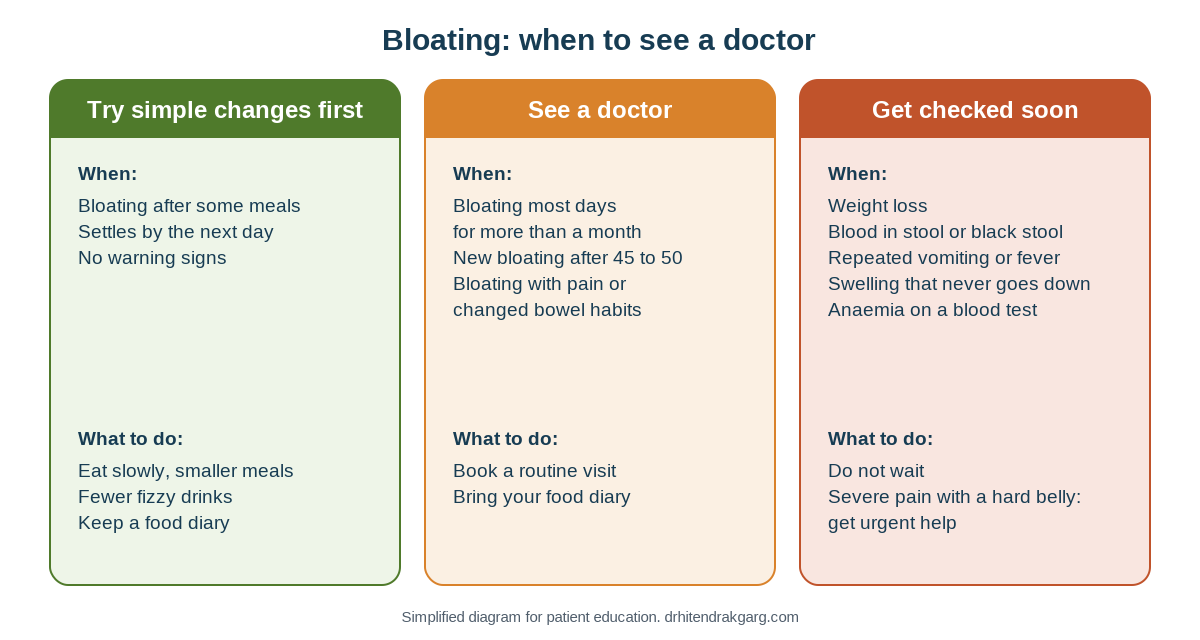
Get urgent medical help if you have severe tummy pain with a hard, swollen belly. The same applies if you cannot pass stool or wind at all, or keep vomiting. These can be signs of a blocked bowel.
How do doctors find the cause of bloating?
Doctors find the cause of bloating mainly by asking questions and examining your tummy. Tests are chosen based on your answers, not done for everyone.
A gastroenterologist will want to know when the bloating started and how it relates to meals and stools. Your periods matter too, along with any medicines you take. Bring a diary. Two weeks of notes on what you ate, when you felt bloated and what your stools were like will often tell your doctor more than a test.
Tests your doctor may suggest:
- Blood tests: blood count, thyroid, and a celiac screen
- Stool tests: for infection, H. pylori or bowel inflammation
- Breath tests: for lactose intolerance or SIBO
- Ultrasound of the abdomen: to look for fluid, liver problems or ovarian cysts
- Endoscopy or colonoscopy: when there are warning signs or a need to see the lining; read about colonoscopy
The American Gastroenterological Association advises that most people with bloating do not need many tests. Tests are for warning signs or when the story points to a specific cause (Moshiree and colleagues, AGA Clinical Practice Update, Gastroenterology, 2023).
How is bloating treated?
Bloating is treated by fixing its cause. When there is no single cause, a mix of eating habits, bowel care and, for some people, medicine usually brings it under control.
Daily habits that help with gas and bloating
- Eat slowly and chew well
- Have smaller meals rather than one or two heavy ones
- Cut back on cola, soda and chewing gum
- Soak dals and rajma well and cook them fully; start with small portions
- Take a 10 to 15 minute walk after meals
- Finish dinner two to three hours before bed
Treating the cause
If constipation is behind it, treat that first. The bloating often clears with it. If milk is the problem, try curd instead. That may be enough. An H. pylori infection is treated with a course of antibiotics and acid-reducing tablets. Celiac disease needs a strict gluten-free diet for life.
When the gut is sensitive
For bloating linked to IBS or a sensitive gut, doctors may suggest a short, planned low-FODMAP diet. They may also prescribe medicines that calm the gut nerves. Some are low-dose medicines first made for depression, used here at small doses for gut pain, not for mood. For a belly that pushes out after meals, slow belly breathing (diaphragmatic breathing) can help retrain the reflex. The AGA update supports both approaches.
What about probiotics? The same AGA update does not recommend them for bloating, because the evidence is weak. Over-the-counter gas drops and enzyme tablets help some people and do nothing for others, so there is little harm in a short trial but no reason to keep buying them if you feel no change after a couple of weeks.
Don't stop your prescribed medicines without talking to your doctor. If you think a medicine is causing your bloating, ask whether it can be changed.
Bloating: myths and facts
A lot of advice about bloating is passed on by word of mouth. Here is what the evidence says.
| Myth | Fact |
|---|---|
| Bloating means you have too much gas. | Many people with bloating have normal amounts of gas. Their gut is more sensitive to it. |
| Everyone with bloating should go gluten-free. | Only people with celiac disease or a proven wheat problem need to. Get a celiac test before cutting out wheat. |
| Probiotics fix bloating. | The AGA does not recommend probiotics for bloating, because good evidence is lacking. |
| More fibre always helps. | Fibre helps constipation, but some types add gas. Increase it slowly and drink water. |
| Bloating is always just gas. | Usually it is harmless, but weight loss, blood in the stool or a swelling that stays need a check. |
| A swollen belly by evening means something is growing. | A belly that is flat in the morning and swollen by night is more often the belly-wall reflex or IBS. |
Living with bloating
Most bloating can be eased once you know what drives it. Start small. A symptom diary and the habits above are enough for many people. If there is no change after a few weeks, or you notice any warning sign, see a gastroenterologist. Bloating that comes with heartburn may be linked to acid; read when daily acidity needs attention. If your symptoms include diarrhoea with blood, read about inflammatory bowel disease.
Frequently asked questions
What is the most common cause of bloating?
The most common causes are swallowed air and gas-forming foods such as rajma and chole. Constipation and IBS are the next most common. In many people, a sensitive gut makes normal amounts of gas feel uncomfortable. Large surveys find that roughly 1 in 7 to 1 in 5 adults have bloating each week.
Why is my stomach bloated every day?
Daily bloating is often linked to IBS or constipation. Foods you eat every day can be the cause. Think of milk and wheat. A two-week food and symptom diary helps find the pattern. If daily bloating is new and has lasted more than a few weeks, or comes with weight loss or blood in the stool, see a doctor.
How do I get rid of bloating fast?
A short walk can ease bloating within an hour. Loosen tight clothes and try slow belly breathing. Avoid fizzy drinks and gum for the rest of the day. If you are constipated, passing stool often brings relief. These steps ease symptoms but do not treat the cause.
Which foods cause gas and bloating?
Rajma and chole are common triggers. So are most dals. Onion and garlic bother many people. Wheat and cabbage affect some, and so do milk and sugar-free sweets. Not everyone reacts to all of them. A planned low-FODMAP trial with a dietitian can show which ones matter for you.
When is bloating serious?
Bloating needs a prompt check if it comes with weight loss or blood in the stool. Black stools and repeated vomiting are warning signs too. So are fever and anaemia. Trouble swallowing needs a check, as does a swelling that never goes down. New symptoms after age 45 to 50 also need a check. Get urgent help for severe pain with a hard belly or if you cannot pass stool or wind.
Can stress cause bloating?
Yes. The gut and brain are closely linked, and stress can make the gut more sensitive and change how fast food moves through it. This is one reason bloating is common in IBS. Slow breathing helps. Regular sleep and exercise help too.
Do probiotics help bloating?
The evidence is weak. The American Gastroenterological Association does not recommend probiotics for treating bloating. Some people feel better on them, but it is better to look for the cause first.

References
- Ballou S, Singh P, Nee J, et al. Prevalence and Associated Factors of Bloating: Results From the Rome Foundation Global Epidemiology Study. Gastroenterology. 2023;165(3):647-655.e4. Source
- Oh JE, Chey WD, Spiegel B. Abdominal Bloating in the United States: Results of a Survey of 88,795 Americans Examining Prevalence and Healthcare Seeking. Clin Gastroenterol Hepatol. 2023;21(9):2370-2377. Source
- Moshiree B, Drossman D, Shaukat A. AGA Clinical Practice Update on Evaluation and Management of Belching, Abdominal Bloating, and Distention: Expert Review. Gastroenterology. 2023;165(3):791-800. Source
- Abraham P, et al. Self-reported food intolerances in an Indian population: need for individualization rather than a universal low-FODMAP diet. JGH Open. 2023. Source
- NHS. Ovarian cancer: symptoms. Source
Medical disclaimer: This article is for general education and is not a substitute for a consultation. Please see a doctor for advice about your own symptoms. Read our editorial policy.