Chronic Constipation: Causes and Treatment
Hard stools and straining are among the most common reasons adults see a gastroenterologist. So is that stuck, unfinished feeling. This guide explains what causes chronic constipation and which treatments have good evidence behind them. It also covers when you need tests.
In short
Chronic constipation means hard or infrequent stools, or straining and a feeling of not emptying fully. It lasts three months or more. It affects about 1 in 10 adults worldwide, and women more than men. Treatment usually starts with fibre such as isabgol (psyllium), enough water and a regular toilet routine. If that is not enough, an osmotic laxative such as polyethylene glycol (PEG) is a well-supported next step. Some people strain because the pelvic floor muscles do not relax, and they do better with biofeedback therapy than with laxatives. See a doctor if constipation is new after 45 to 50. Blood in the stool, weight loss and severe pain also need a check.
Constipation is easy to joke about and hard to live with. It can mean long minutes on the toilet every morning and a heavy belly all day. Travel becomes a worry. Most cases respond to simple steps, though. That is the good part. This guide covers the causes first, then the treatment options in the order doctors usually try them.
What is chronic constipation?
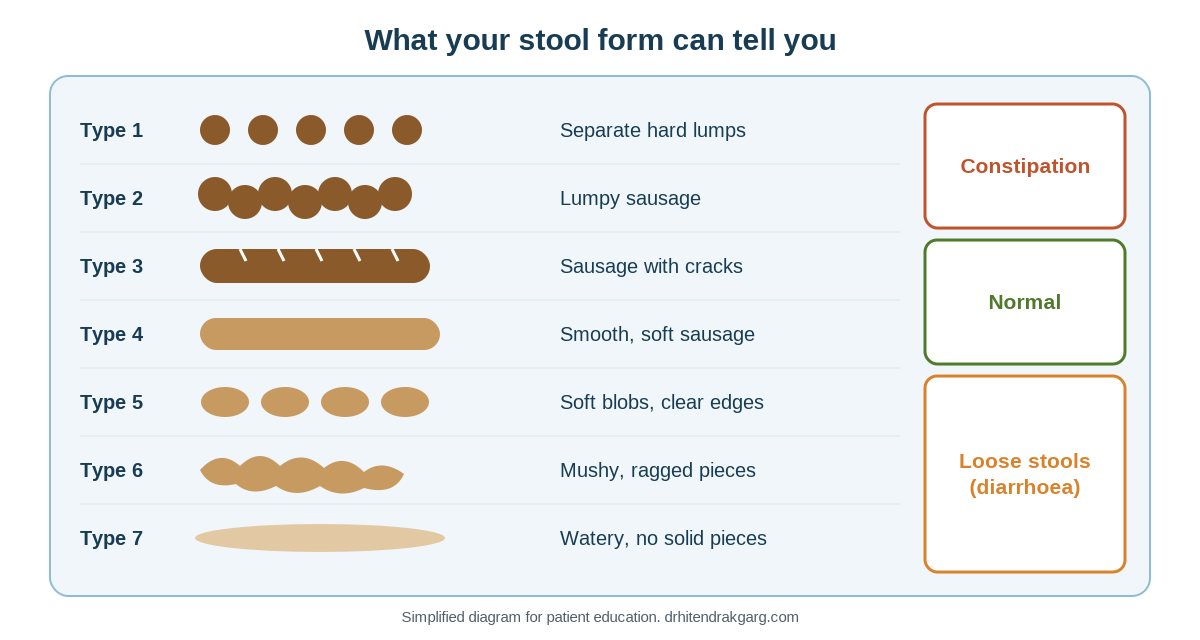
Chronic constipation means bowel movements that are hard to pass or do not feel complete, or that happen too rarely. It has gone on for at least three months. Frequency is only part of it.
Doctors use the Rome IV criteria. You have constipation if at least a quarter of your bowel movements involve two or more of these:
- Straining
- Hard or lumpy stools
- A feeling that you have not emptied fully
- A feeling of blockage at the back passage
- Needing to press around the anus or use a finger to pass stool
- Fewer than three bowel movements a week
Indian doctors add a practical point. The Indian consensus on chronic constipation says stool form and your own sense of being constipated matter more than counting visits. Many Indians go once or twice a day, and some feel constipated even when they go daily, because the stool is hard or the emptying is poor (Ghoshal and colleagues, Indian consensus on chronic constipation, Indian Journal of Gastroenterology, 2018).
How common is constipation in adults?
Constipation in adults is common. Around 1 in 10 adults worldwide has it, and women are affected roughly twice as often as men.
A review pooled 45 studies with more than 275,000 adults. Using the current Rome IV criteria, 10.1% had functional constipation (Barberio and colleagues, Lancet Gastroenterology & Hepatology, 2021).
Indian figures vary with how constipation is defined. In a survey of 2,774 people in rural north India quoted in the Indian consensus, about 1 in 4 passed mostly hard stools.
Constipation in older adults and in pregnancy
Constipation gets more common with age. Older adults tend to move less and drink less. Many take several medicines, and some of these slow the bowel. Weak tummy and pelvic muscles make pushing harder. In someone who is frail or bedbound, hard stool can pack into the rectum (faecal impaction). Oddly, this can show up as leaking loose stool, which is easy to mistake for diarrhoea.
Pregnancy is another common time. Hormones relax the bowel muscle and the growing womb presses on the bowel. Iron tablets add to it. Fibre, water and walking are the first steps. Isabgol and lactulose are widely used in pregnancy, but check with your obstetrician before starting any laxative.
What are the main constipation causes?
The main constipation causes are a low-fibre diet and too little movement. Medicines are next. Then come problems with how the bowel or the pelvic floor muscles work. Often there is more than one cause.
Daily habits
Refined foods are a big one. White rice and maida have little fibre. Neither do biscuits or most bakery items. A desk job and a long commute mean less movement, and the bowel slows down with you. Ignoring the urge because the office toilet is unpleasant, or because you are rushing out in the morning, teaches the bowel to hold on. Travel and changes in routine do the same.
Medicines
Many common medicines cause constipation. Check your list if it started after a new prescription.
- Iron and calcium tablets
- Strong painkillers such as tramadol and codeine (in some cough syrups)
- Some blood pressure medicines, such as amlodipine and verapamil
- Antacids that contain aluminium
- Some medicines for depression, allergies, bladder control and Parkinson's disease
Don't stop your prescribed medicines without talking to your doctor. There is often a switch or an add-on that fixes the problem.
Medical conditions
An underactive thyroid can slow the bowel. So can high blood calcium and long-standing diabetes. Nerve conditions such as Parkinson's disease and spinal injury affect it too. Pregnancy hormones relax the bowel muscle too.
How the bowel and pelvic floor work
Some people have constipation with no outside cause. Doctors then look at two things.
- Slow transit: the colon moves stool along more slowly than normal.
- Pelvic floor dyssynergia: when you push, the muscles around the back passage tighten instead of relaxing. You strain hard and still cannot empty, even when the stool is soft.
This second problem is common in people who have strained for years. Spotting it matters. Laxatives help it far less than muscle retraining does, so people can spend years trying one tablet after another without getting to the real cause.
IBS with constipation
If tummy pain is a major part of the picture and it eases after you pass stool, you may have IBS with constipation (IBS-C). Bloating is common with it. See our guide to IBS and our article on bloating causes.
Types of chronic constipation compared
Type matters. Knowing it helps choose the treatment.
| Type | What is going on | Typical clues | Usual treatment |
|---|---|---|---|
| Normal transit (most common) | Bowel moves at a normal speed, but stools are hard | Hard stools, straining; better with fibre | Fibre, water, osmotic laxatives |
| Slow transit | Colon moves stool slowly | Few urges to go; little response to fibre | Osmotic or stimulant laxatives, prescription medicines |
| Pelvic floor dyssynergia | Muscles tighten instead of relaxing when you push | Heavy straining even with soft stool; using fingers to help | Biofeedback therapy |
| IBS with constipation | Sensitive gut with slow, hard stools | Pain that eases after a stool; bloating | Fibre, diet changes, gut-directed medicines |
| Secondary | Caused by a medicine or another illness | Started with a new tablet or condition | Treat or change the cause |
When should you see a doctor for constipation?
See a doctor if home steps have not helped after two to three weeks. Go sooner if your bowel habit has changed for no clear reason, especially after the age of 45 to 50.
Get checked promptly if constipation comes with:
- Blood in the stool or black stools
- Weight loss without trying
- Anaemia (low blood count)
- Severe or worsening tummy pain
- Thin, pencil-like stools that persist
- A family history of bowel cancer or inflammatory bowel disease
Get urgent medical help if you cannot pass stool or wind at all and your belly is swollen and painful, or if you are vomiting. These can be signs of a blocked bowel.
Pain or bright red blood when passing hard stool is often from a small tear called a fissure, or from piles. Read about anal fissures and piles. Even so, blood should always be checked by a doctor. Always.
How is chronic constipation diagnosed?
Most chronic constipation is diagnosed from your history and a physical exam. Tests are used when there are warning signs or when first steps fail.
Your doctor will ask how long it has been going on and what your stools look like. Expect questions about straining and diet. Bring your medicine list. A gentle finger exam of the back passage is a quick, useful check. It can show piles or a fissure. It also shows whether the muscles are tight, and how well you push.
Possible tests include:
- Blood tests: blood count, thyroid, calcium and sugar
- Colonoscopy: if you have warning signs or are due for bowel screening; read about colonoscopy and how to prepare
- Anorectal manometry and balloon expulsion test: measure how the back-passage muscles work, to find pelvic floor dyssynergia
- Colon transit study: shows how fast stool moves through the colon
Constipation treatment: what works?
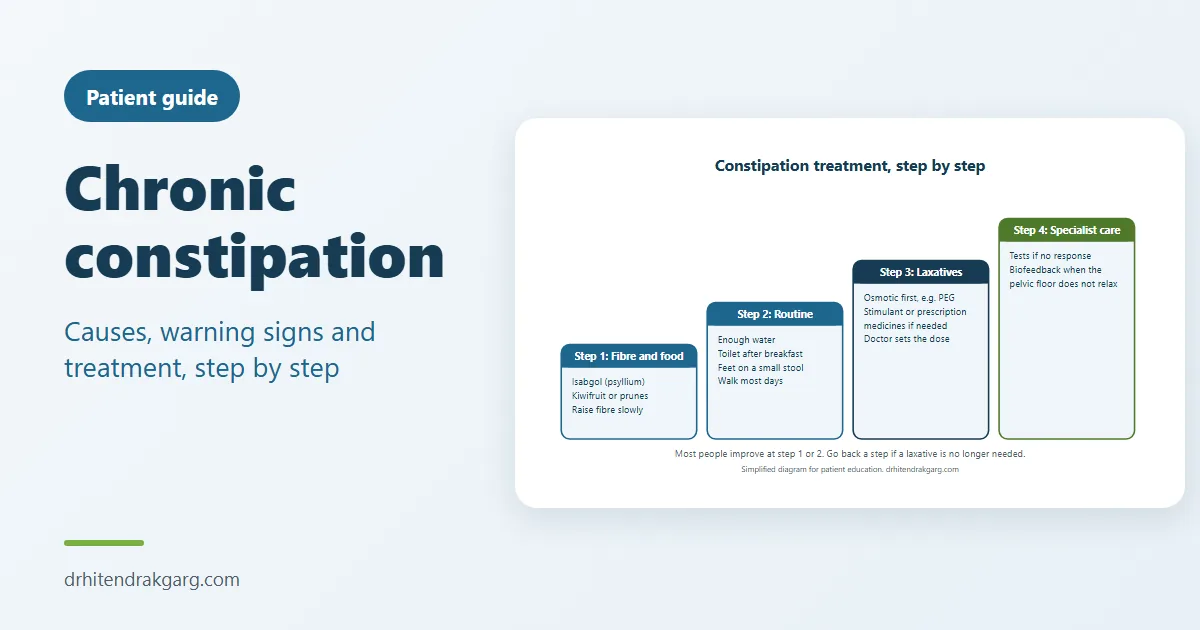
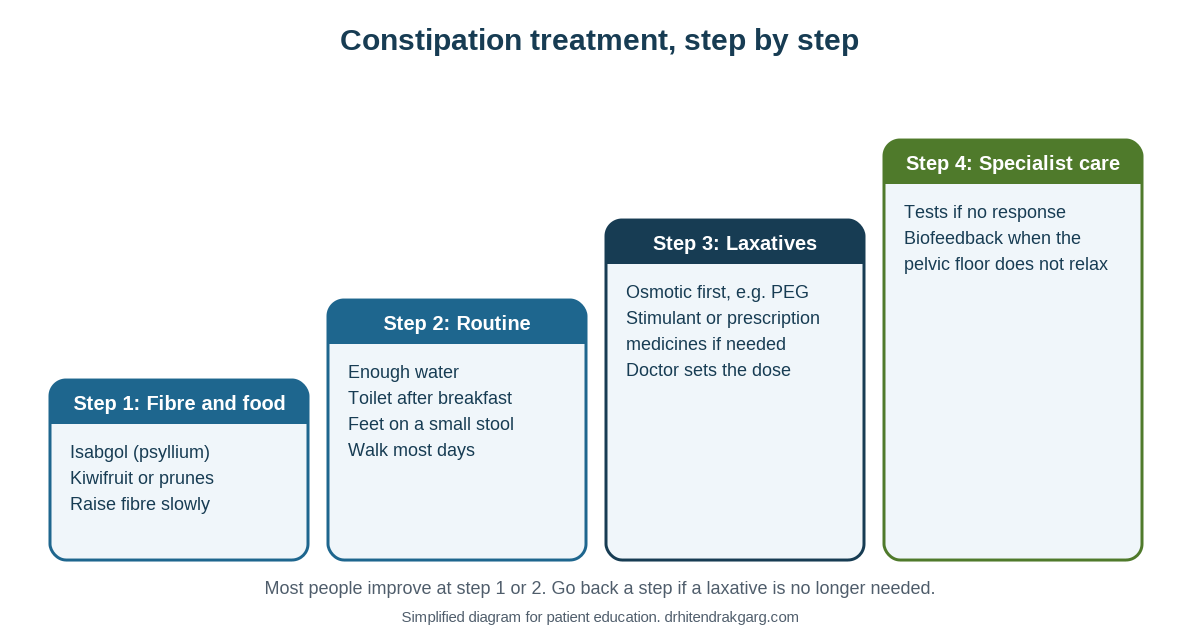
Constipation treatment works well in steps. Start with fibre and a daily routine. Add a laxative if that is not enough. When the pelvic floor is the problem, specialist therapy works better than any tablet.
Step 1: Fibre and food
Fibre holds water in the stool and makes it softer and bulkier. Isabgol (psyllium husk) is the most studied fibre and is easy to find in India. New dietary guidelines from King's College London, backed by the British Dietetic Association, support psyllium at 10 grams or more a day (Dimidi and colleagues, dietary guidelines for chronic constipation, 2025). The same guidelines found that general advice to "eat more fibre" had weaker support than specific foods.
Kiwifruit and prunes have the strongest evidence among foods. A US trial compared two green kiwifruit a day with prunes or psyllium for four weeks. All three increased complete bowel movements. Kiwifruit caused the fewest side effects (Chey and colleagues, American Journal of Gastroenterology, 2021).
Indian kitchens have plenty of fibre too. Whole dals and chana help. So do millets like bajra and jowar, and fruit eaten with the skin.
Go slow. Raise fibre over two to three weeks. A sudden jump causes gas and bloating, which is why so many people give up on isabgol after a few days and decide it does not work for them.
Step 2: Water, movement and a toilet routine
- Drink enough water, especially when you take isabgol; it needs water to work
- Walk or exercise most days
- Sit on the toilet 15 to 30 minutes after breakfast, when the bowel is naturally most active
- Do not ignore the urge to go
- On a Western toilet, rest your feet on a small stool so your knees are above your hips
That last tip copies the squatting position of an Indian-style toilet. It straightens the angle at the end of the bowel so stool passes more easily.
Step 3: Laxatives
If fibre and habits are not enough, laxatives are safe and effective for most adults. The 2023 guideline from the American Gastroenterological Association and the American College of Gastroenterology gave a strong recommendation to five medicines (Chang and colleagues, AGA/ACG constipation guideline, 2023):
- Polyethylene glycol (PEG)
- Sodium picosulfate
- Prucalopride
- Linaclotide
- Plecanatide
Fibre and lactulose got a conditional recommendation. So did senna and magnesium oxide, along with lubiprostone. That means they can help, but the evidence is less certain.
| Type | Examples | How it works | Points to know |
|---|---|---|---|
| Bulk-forming | Isabgol (psyllium) | Adds bulk and holds water | Take with plenty of water; can cause gas at first |
| Osmotic | PEG, lactulose, magnesium salts | Draws water into the bowel | PEG works in 1 to 3 days; lactulose can cause gas; magnesium needs care in kidney disease |
| Stimulant | Senna, bisacodyl, sodium picosulfate | Makes the bowel muscle contract | Works overnight; can cause cramps |
| Prescription medicines | Prucalopride, linaclotide, lubiprostone | Speed up the bowel or add fluid to it | Used when other laxatives have not worked |
Your doctor will pick the type and dose. Many people need a laxative for months, and that is fine when it is supervised.
Biofeedback for pelvic floor dyssynergia
When the pelvic floor muscles tighten instead of relaxing, laxatives only go so far. Biofeedback therapy teaches you to relax them. A sensor shows on a screen what your muscles are doing while you practise pushing.
In a US trial of 77 people with this problem, biofeedback corrected the muscle pattern in 79% after three months. With sham feedback the figure was 4%, and with standard treatment (diet and exercise plus laxatives) it was 6% (Rao and colleagues, Clinical Gastroenterology & Hepatology, 2007).
Surgery
Surgery is rare. It is considered only for a small group with severe slow-transit constipation after full testing, when every other step has failed.
Constipation, piles and fissures
Constipation and straining are the most common triggers for piles and anal fissures. Hard stools stretch and tear the lining of the back passage. Straining pushes blood into the veins there and makes them swell.
Treating the constipation is part of treating both. Softer stools let a fissure heal and stop piles from getting worse. Our guide to fissure vs piles explains how to tell them apart.
Constipation: myths and facts
Many beliefs about constipation are handed down in families. Here is what the evidence says.
| Myth | Fact |
|---|---|
| You must pass stool every day. | Normal ranges from three times a day to three times a week. Hard stools and straining matter more than the count. |
| Laxatives make the bowel lazy. | There is no good evidence that laxatives taken as advised damage the bowel. Long-term use under a doctor's care is common and accepted. |
| Drinking lots of water fixes constipation. | Water helps if you are not drinking enough, and fibre needs it. Extra water beyond that does little on its own. |
| More fibre always helps. | Fibre helps most people. In slow transit or pelvic floor problems, it can add bloating without much benefit. |
| Constipation is just a diet problem. | Medicines, thyroid disease, pregnancy and pelvic floor problems are common causes too. |
| Straining harder will help. | Heavy straining can cause piles and fissures. If you have to strain hard, see a doctor. |
Living with chronic constipation
Most people with chronic constipation feel much better once they find the right mix. For many it is isabgol and a morning routine. A laxative covers the bad days. Keep a simple record of your stools for two weeks before your appointment. Note how hard they were and how much you strained. If you also have bloating or tummy pain, an IBS diet may help. Gentle, easily digestible Indian foods are a good choice when your stomach is unsettled.
Frequently asked questions
What is the fastest treatment for constipation?
A stimulant laxative such as bisacodyl or senna usually works overnight, and a glycerine suppository can work within an hour. These are for short-term relief. For chronic constipation, fibre and a daily routine work better over time. Polyethylene glycol (PEG) can be added if needed. Ask your doctor before using laxatives regularly.
How many days without a bowel movement is too long?
Three or more days without a bowel movement counts as constipation, especially with hard stools or straining. If you have not passed stool or wind for several days and your belly is swollen and painful, or you are vomiting, get urgent medical help.
Is isabgol good for constipation?
Yes. Isabgol (psyllium husk) is the most studied fibre for constipation, and recent dietary guidelines support at least 10 grams a day. Take it with a full glass of water and increase it slowly to avoid gas. It may not help much if your constipation is due to pelvic floor problems.
Is it safe to take laxatives every day?
For most adults, laxatives such as PEG are safe for long-term use when a doctor supervises them. There is no good evidence that they make the bowel lazy. Don't stop your prescribed medicines without talking to your doctor, and tell your doctor if you need more and more to get the same effect.
What causes chronic constipation in adults?
Common causes are a low-fibre diet and too little exercise. Medicines are another big cause, including iron tablets and calcium. Some blood pressure tablets do it too. Thyroid disease and diabetes can contribute. Some people have a slow colon, or pelvic floor muscles that tighten instead of relaxing.
Which fruits help with constipation?
Kiwifruit and prunes have the strongest evidence. In one trial, two green kiwifruit a day worked about as well as prunes or psyllium, with fewer side effects. Other fruits eaten with their skin add fibre too.
When should I see a gastroenterologist for constipation?
See a gastroenterologist if constipation lasts more than a few weeks despite home steps, or if it is new after the age of 45 to 50. See one promptly if you notice blood in the stool or weight loss. Anaemia and severe pain need a check too. So does having to use your fingers to pass stool.

References
- Chang L, Chey WD, Imdad A, et al. American Gastroenterological Association-American College of Gastroenterology Clinical Practice Guideline: Pharmacological Management of Chronic Idiopathic Constipation. Am J Gastroenterol. 2023;118(6):936-954. Source
- Barberio B, Judge C, Savarino EV, Ford AC. Global prevalence of functional constipation according to the Rome criteria: a systematic review and meta-analysis. Lancet Gastroenterol Hepatol. 2021;6(8):638-648. Source
- Ghoshal UC, Sachdeva S, Pratap N, et al. Indian consensus on chronic constipation in adults: a joint position statement of the Indian Motility and Functional Diseases Association and the Indian Society of Gastroenterology. Indian J Gastroenterol. 2018;37(6):526-544. Source
- Dimidi E, et al. British Dietetic Association-endorsed evidence-based guidelines for the dietary management of chronic constipation in adults. 2025 (PubMed 41081513). Source
- Chey SW, Chey WD, Jackson K, Eswaran S. Exploratory Comparative Effectiveness Trial of Green Kiwifruit, Psyllium, or Prunes in US Patients With Chronic Constipation. Am J Gastroenterol. 2021;116(6):1304-1312. Source
- Rao SSC, Seaton K, Miller M, et al. Randomized controlled trial of biofeedback, sham feedback, and standard therapy for dyssynergic defecation. Clin Gastroenterol Hepatol. 2007;5(3):331-338. Source
Medical disclaimer: This article is for general education and is not a substitute for a consultation. Please see a doctor for advice about your own symptoms. Read our editorial policy.