IBS Diet: An Indian Low-FODMAP Guide
Food is one of the strongest triggers for IBS, and Indian meals bring their own challenges. Onion and garlic go into almost everything. Rajma and chole are weekly staples. This guide shows how to adjust your diet in steps, without giving up Indian food.
In short
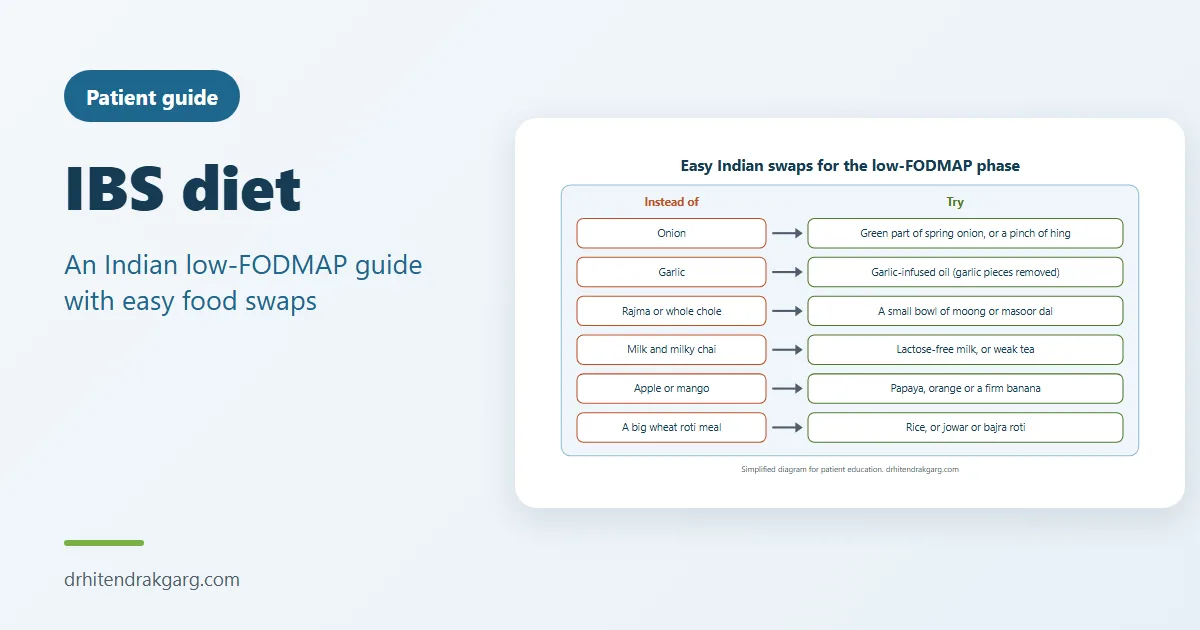
An IBS diet usually starts with simple changes. Eat regular meals and cut back on tea and fizzy drinks. Add soluble fibre such as isabgol. If symptoms continue, a low-FODMAP diet is the most studied next step. It has three phases. You cut down high-FODMAP foods for 2 to 6 weeks and then add them back one at a time. After that, you keep only the limits you need. In Indian meals, the main high-FODMAP foods are onion and garlic, rajma and chole, and milk. Large amounts of wheat count too, as do apples and mangoes. The diet is easier with a dietitian, and it is not meant to be followed strictly for life.
Ask anyone with irritable bowel syndrome (IBS) what sets it off, and food comes up again and again. A heavy rajma-chawal lunch. Chai with extra milk. A plate of chole bhature on a Sunday. This guide explains which foods tend to cause trouble and why. It also shows how to change your diet step by step, so you can still eat the food you grew up with.
If you are not sure you have IBS, start with our guide to IBS symptoms and treatment. Diet changes should come after a doctor has ruled out other causes.
Does diet really help IBS?
Yes. Diet is one of the most effective treatments for IBS symptoms, and it helps bloating and tummy pain the most. It does not change the underlying condition. What it can do is make ordinary days, office lunches and family meals far easier to get through.
IBS is common. A review of 53 studies from 38 countries found that 9.2% of adults met the Rome III criteria for IBS. Under the stricter Rome IV criteria, the figure was 3.8% (Oka and colleagues, Lancet Gastroenterology & Hepatology, 2020).
Many people with IBS notice that certain foods make them worse. In a Mumbai survey, 72.1% of people with IBS reported trouble with at least one food, compared with 44.8% of healthy adults. The foods varied a lot from person to person (Abraham and colleagues, JGH Open, 2023). That is why a good IBS diet is personal. No single list suits everyone.
Step 1: Simple IBS diet changes to try first
The first step of an IBS diet is simple advice about meal timing and drinks, plus the right type of fibre. Guidelines from the UK and the US suggest trying this before stricter diets.
The UK's National Institute for Health and Care Excellence (NICE IBS guideline) and the British Society of Gastroenterology IBS guideline (2021) suggest these first steps:
- Eat regular meals and do not skip breakfast or leave long gaps
- Take time to eat, and chew well
- Keep tea and coffee to about three cups a day
- Cut down on alcohol and fizzy drinks
- Limit fresh fruit to three portions a day
- Avoid sorbitol, the sweetener in many sugar-free products, if you have loose stools
- Go easy on bran and very coarse, high-fibre foods
Fibre type matters. Soluble fibre, such as isabgol (psyllium husk), helps IBS symptoms. Insoluble fibre, such as wheat bran, can make bloating worse. The American College of Gastroenterology recommends soluble fibre but not insoluble fibre for IBS (Lacy and colleagues, ACG IBS guideline, 2021). Start with a teaspoon a day and build up slowly.
Many people feel better with these changes alone. Give them four weeks. Then judge.
What is the low-FODMAP diet?
The low-FODMAP diet is a short-term eating plan that cuts down certain sugars and fibres that the gut absorbs poorly. It is the most studied diet for IBS.
FODMAP stands for fermentable oligosaccharides, disaccharides, monosaccharides and polyols. These are carbohydrates found in many healthy foods. In plain words:
- Fructans: in wheat, onion and garlic
- GOS (galacto-oligosaccharides): in rajma, chole and many dals
- Lactose: the sugar in milk
- Fructose (in excess): in mango, apple and honey
- Polyols: in apples, mushrooms and sugar-free sweets
These sugars pull water into the bowel and are fermented by gut bacteria, which makes gas. In most people this causes no trouble. In IBS, the gut is more sensitive, so the same amount of gas and water causes pain and bloating, along with diarrhoea in some people and constipation in others.
Does it work? The evidence is good. A network review of 13 trials with 944 people compared the low-FODMAP diet with other diets for IBS. It ranked first for overall symptoms and for bloating (Black and colleagues, Gut, 2022).
It has been tested in India too. In a Ludhiana trial of 101 people with diarrhoea-predominant IBS, 62.7% improved on a low-FODMAP diet after four weeks, compared with 40.8% on standard diet advice. At 16 weeks the figures were 52.9% and 30.6%. Sticking to the diet fell from 93% at four weeks to 64% at 16 weeks, which shows how hard it is to keep up (Goyal and colleagues, 2021).
Step 2: How to follow a low-FODMAP diet in India
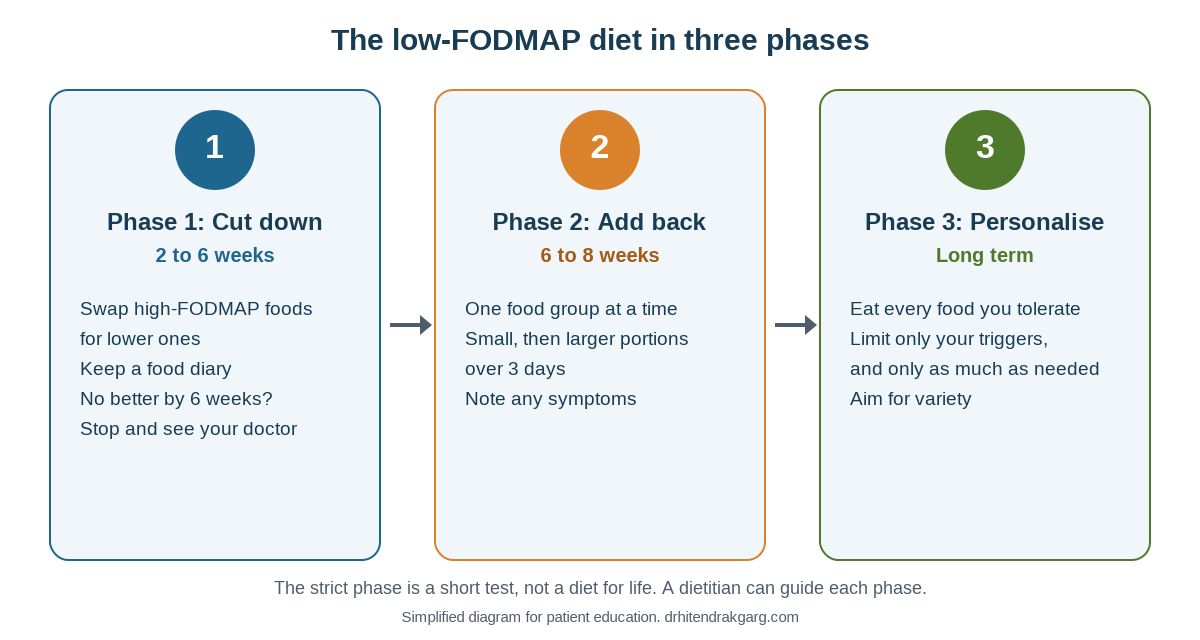
A low-FODMAP diet has three phases: cut down, add back, then personalise. The cutting-down phase should last only two to six weeks.
Phase 1: Cut down (2 to 6 weeks)
Swap high-FODMAP foods for lower-FODMAP choices from the same food group. The food list below shows Indian options. Portion size matters, because many foods are fine in small amounts and cause trouble only in large ones. Keep a diary of what you eat and how you feel.
If your symptoms do not improve after six weeks, stop. The diet may not be right for you, and your doctor should look at other options.
Phase 2: Add back (6 to 8 weeks)
Most people skip this step. Do not. It matters most. Add back one FODMAP group at a time, over three days, in growing amounts. For example, try a small bowl of rajma on day one and a larger one on day three. Note any symptoms. Go back to your phase 1 diet for a few days before testing the next group.
Phase 3: Personalise (long term)
Bring back every food you tolerate. Limit only the ones that clearly cause symptoms, and only to the amount that bothers you. By the end, most people are avoiding just a handful of foods, or simply eating smaller portions of them, rather than giving up whole food groups that their family cooks every week.
Indian low-FODMAP food list
This list shows common Indian foods grouped by FODMAP content. It is based on testing by Monash University, which developed the diet. Serving sizes change the rating, so use it as a guide, and check the Monash FODMAP app or a dietitian for details.
| Food group | Lower-FODMAP choices | Higher-FODMAP: limit in phase 1 |
|---|---|---|
| Grains | Rice, poha, oats, makki (maize), jowar, bajra, kuttu (buckwheat) | Wheat roti, paratha, bread and sooji in large amounts; maida bakery items |
| Dals and pulses | Small portions (about a quarter cup cooked) of masoor or moong dal; well-rinsed canned chickpeas in small amounts | Rajma, whole chole, large bowls of dal |
| Vegetables | Carrot, tomato, cucumber, palak, potato, baingan, bhindi, capsicum, ginger, green part of spring onion | Onion, garlic, cauliflower, mushrooms, green peas in large amounts |
| Fruit | Firm banana, papaya, orange, kiwi, grapes, pineapple | Apple, mango, watermelon, pear, very ripe banana |
| Milk products | Lactose-free milk and curd, hard cheese, small amounts of paneer, ghee, butter | Milk, kheer, ice cream, large bowls of regular curd (if lactose bothers you) |
| Protein | Eggs, chicken, fish, tofu, plain nuts such as peanuts in small handfuls | Cashews and pistachios in large amounts |
| Flavour | Garlic-infused oil, a pinch of hing, jeera, haldi, ginger, coriander leaves, lemon | Onion and garlic paste, ready-made masalas with onion or garlic powder |
| Drinks and sweets | Water, weak tea, green tea, a small coffee, sugar in small amounts | Milky chai in large amounts, fruit juice, honey, sugar-free sweets with sorbitol |
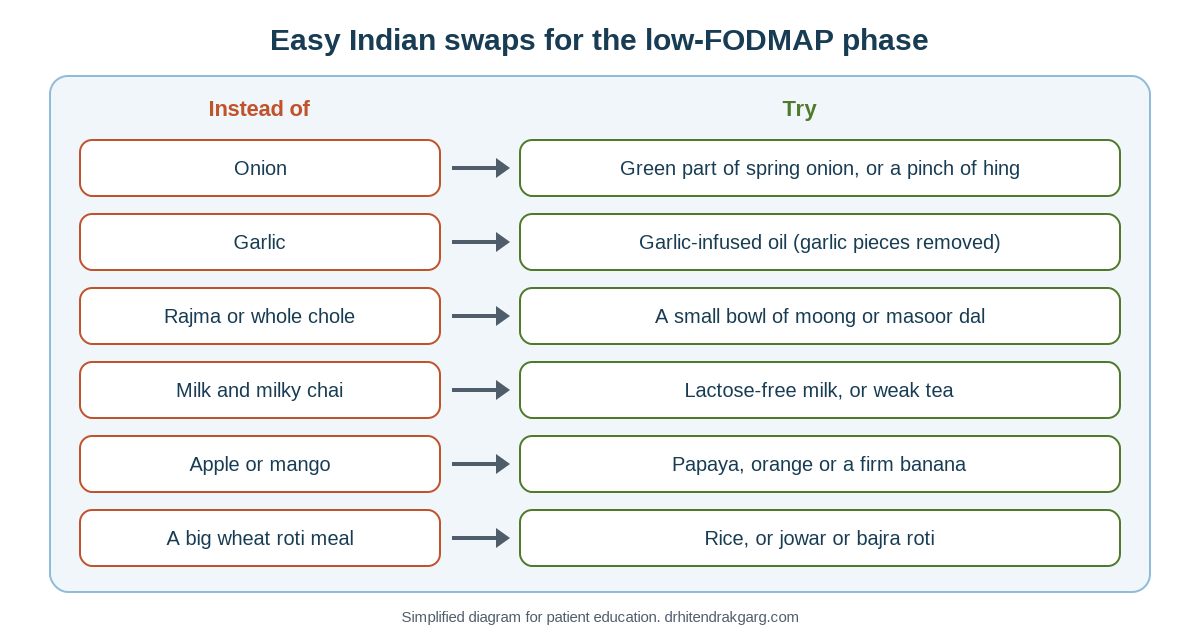
Two tips make Indian cooking easier. Fructans do not dissolve in oil. So fry garlic in oil, then take the pieces out and cook with the flavoured oil. Hing gives an onion-like taste, but many brands mix it with wheat flour, so check the label.
Foods to avoid in IBS
The foods to avoid in IBS depend on your own triggers. Onion and garlic come first. Rajma and chole come next, then milk. Wheat in large amounts and fruits high in fructose, such as mango and apple, are the other usual culprits.
Other things that often make IBS worse, even though they are not FODMAPs:
- Very oily or fried food, such as pakoras, samosas and bhature
- Very spicy food, especially with loose stools
- Large amounts of tea or coffee
- Alcohol
- Big meals late at night
Your symptom type matters as well. With loose stools (IBS-D), caffeine and sugar-free sweets often make things worse. With constipation (IBS-C), too little water and too little soluble fibre are common problems. Read more in our guide to chronic constipation and its treatment.
Diet approaches for IBS compared
Several diets are promoted for IBS. Few have strong evidence.
| Approach | What it involves | Evidence for IBS | Most useful for |
|---|---|---|---|
| First-step diet advice | Regular meals, less caffeine, alcohol and fizzy drinks, fruit limits | Recommended first by NICE and the British Society of Gastroenterology | Everyone with IBS |
| Soluble fibre (isabgol) | Adding psyllium husk slowly | Recommended by the ACG | IBS overall, especially with constipation |
| Low-FODMAP diet | Cut down, add back, personalise | Ranked first in a review of 13 trials; tested in India | Bloating and pain that persist after first steps |
| Gluten-free diet | No wheat, barley or rye | Not recommended for IBS by the British Society of Gastroenterology | People with proven celiac disease |
| Probiotics | Capsules, drinks or curd with live bacteria | ACG suggests against them for overall IBS symptoms | No clear group; evidence is mixed |
If you think wheat is a problem, get tested for celiac disease before you cut it out. The blood test works only while you are still eating wheat. Read about celiac disease.
A sample low-FODMAP day for Indian meals
Here is one example of a low-FODMAP day built from everyday Indian food. Portion sizes are for an average adult. A dietitian can adjust them for you.
- Early morning: weak tea with lactose-free milk, or green tea
- Breakfast: poha with peanuts, carrot and curry leaves, cooked without onion; or two idlis with tomato chutney
- Mid-morning: a bowl of papaya or a firm banana
- Lunch: rice, a small bowl of moong dal tempered with jeera and hing, bhindi sabzi and cucumber salad
- Evening: a small handful of roasted peanuts and a cup of green tea
- Dinner: jowar roti or rice, chicken, fish or paneer curry made with tomato and ginger, and palak or carrot sabzi
For softer meals on days when your stomach is unsettled, see our list of easily digestible Indian foods.
Is the low-FODMAP diet safe?
The low-FODMAP diet is safe for most adults when it is followed for a short time and then relaxed. The trouble starts when people stay on the strict phase for months because they are afraid that bringing foods back will make them ill again.
- Nutrition: cutting many foods can lower fibre and calcium intake
- Gut bacteria: FODMAPs feed helpful bacteria; long-term restriction may reduce them
- Eating worries: strict food rules can make some people anxious about eating
This is why phases 2 and 3 matter. The goal is the most varied diet you can manage without symptoms. It is not suitable for people with an eating disorder. Children need specialist advice. So do pregnant women. Don't stop your prescribed medicines without talking to your doctor. Diet works alongside IBS medicines, not instead of them.
IBS diet: myths and facts
A lot of diet advice for IBS is passed around online and in families. Here is what the evidence says.
| Myth | Fact |
|---|---|
| Everyone with IBS should go gluten-free. | Only people with celiac disease need a strict gluten-free diet. In IBS, wheat often bothers people because of its fructans, and cutting down is usually enough. |
| The low-FODMAP diet is for life. | It is a short-term test. Most people bring back most foods within two to three months. |
| More fibre is always better for IBS. | Soluble fibre such as isabgol helps. Bran and other insoluble fibre can make bloating worse. |
| If one food upsets you, the whole group must go. | Portion size matters. Many people tolerate a small bowl of dal but not a large one. |
| Curd always helps IBS. | Curd suits many people, but it contains some lactose, and probiotics have weak evidence for IBS. |
| Diet alone can control every case of IBS. | Diet helps many people, but some also need medicines or gut-directed therapies for stress and pain. |
When to see a doctor or dietitian
See a gastroenterologist before starting a strict diet if your symptoms are new, or if you have not been diagnosed with IBS. A dietitian trained in the low-FODMAP diet can guide you through all three phases.
See a doctor promptly if you have blood in your stool or lose weight without trying. Anaemia needs a check too, as do symptoms that wake you at night and new bowel symptoms after 45 to 50. These are not typical of IBS. Diarrhoea with blood can be a sign of inflammatory bowel disease. If bloating is your main problem, read about common bloating causes.
Frequently asked questions
Which diet helps IBS the most?
There is no single diet that suits everyone. Most guidelines suggest starting with regular meals and less caffeine. Soluble fibre such as isabgol helps too. If symptoms continue, the low-FODMAP diet has the strongest evidence, ideally with a dietitian.
What foods should I avoid with IBS?
Common triggers are onion and garlic, rajma and chole, and milk. Large amounts of wheat can cause trouble, as can apples, mangoes and sugar-free sweets. Fried or very spicy food makes IBS worse for many people. So does alcohol, and so does a lot of tea or coffee. Your own triggers may differ.
Is roti allowed on a low-FODMAP diet?
Wheat contains fructans, so large amounts of roti can cause symptoms in the strict phase. One small roti is often tolerated. Rice is a lower-FODMAP choice. So are jowar and bajra roti, and makki roti. In the add-back phase you can test how much wheat suits you.
Can I eat dal if I have IBS?
Usually, yes, in smaller portions. A small bowl of masoor or moong dal is often tolerated. Rajma and whole chole are higher in FODMAPs and more likely to cause gas and bloating. Soaking and cooking pulses well also helps.
Is curd good for IBS?
Many people with IBS tolerate curd, especially in small amounts. It contains less lactose than milk but not none. Lactose-free curd is an option if lactose bothers you.
How long does the low-FODMAP diet take to work?
Many people notice a change within two to four weeks. If there is no improvement after six weeks, stop the strict phase and talk to your doctor about other treatments.
Can I cook without onion and garlic and still enjoy Indian food?
Yes. Use the green part of spring onion and a pinch of hing (check it is wheat-free). Ginger and jeera add plenty of taste, as does fresh coriander. Garlic-infused oil gives garlic flavour without the fructans. Many Jain recipes are already cooked without onion and garlic.

References
- Lacy BE, Pimentel M, Brenner DM, et al. ACG Clinical Guideline: Management of Irritable Bowel Syndrome. Am J Gastroenterol. 2021;116(1):17-44. Source
- Vasant DH, Paine PA, Black CJ, et al. British Society of Gastroenterology guidelines on the management of irritable bowel syndrome. Gut. 2021;70(7):1214-1240. Source
- National Institute for Health and Care Excellence. Irritable bowel syndrome in adults: diagnosis and management (CG61). Source
- Oka P, Parr H, Barberio B, Black CJ, Savarino EV, Ford AC. Global prevalence of irritable bowel syndrome according to Rome III or IV criteria: a systematic review and meta-analysis. Lancet Gastroenterol Hepatol. 2020;5(10):908-917. Source
- Black CJ, Staudacher HM, Ford AC. Efficacy of a low FODMAP diet in irritable bowel syndrome: systematic review and network meta-analysis. Gut. 2022;71(6):1117-1126. Source
- Goyal O, Batta S, Nohria S, et al. Low fermentable oligosaccharide, disaccharide, monosaccharide, and polyol diet in patients with diarrhea-predominant irritable bowel syndrome: a prospective, randomized trial. 2021 (PubMed 33464683). Source
- Abraham P, et al. Self-reported food intolerances in an Indian population: need for individualization rather than a universal low-FODMAP diet. JGH Open. 2023. Source
- Monash University. The Monash University Low FODMAP Diet. Source
Medical disclaimer: This article is for general education and is not a substitute for a consultation. Please see a doctor for advice about your own symptoms. Read our editorial policy.