Gallbladder Stones vs Bile Duct Stones: Which Need Surgery, Which Need ERCP
Gallstones can sit in two places: the gallbladder or the bile duct. Where a stone is decides how it is treated. This guide gives an honest answer to a question patients ask every week: can my gallstones be treated without surgery?
In short
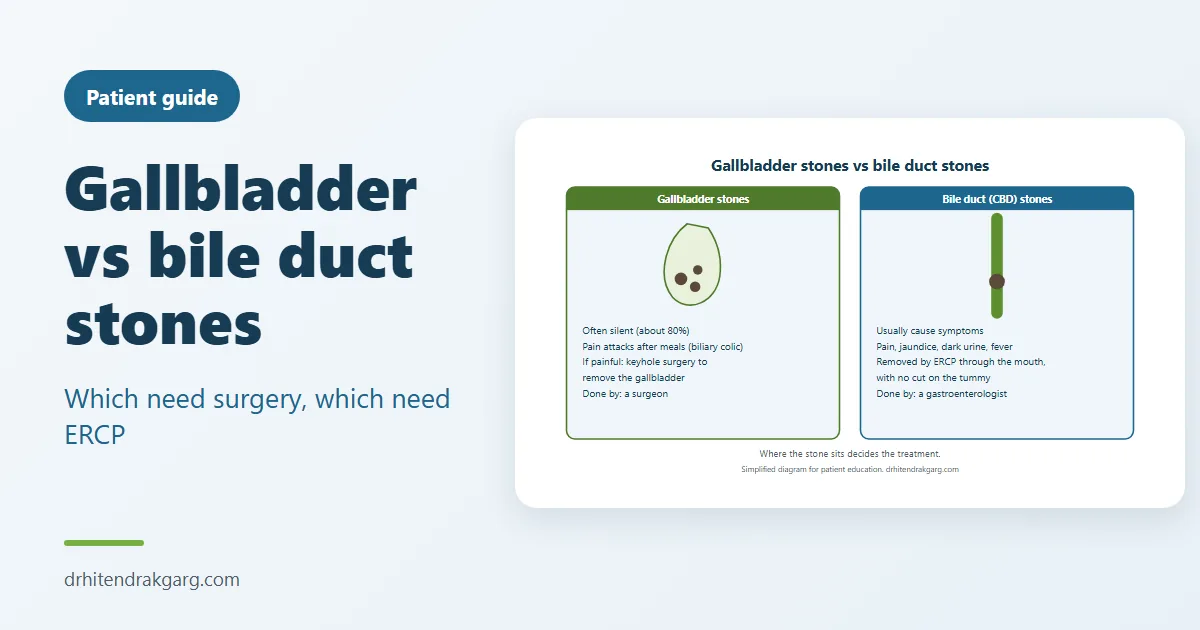
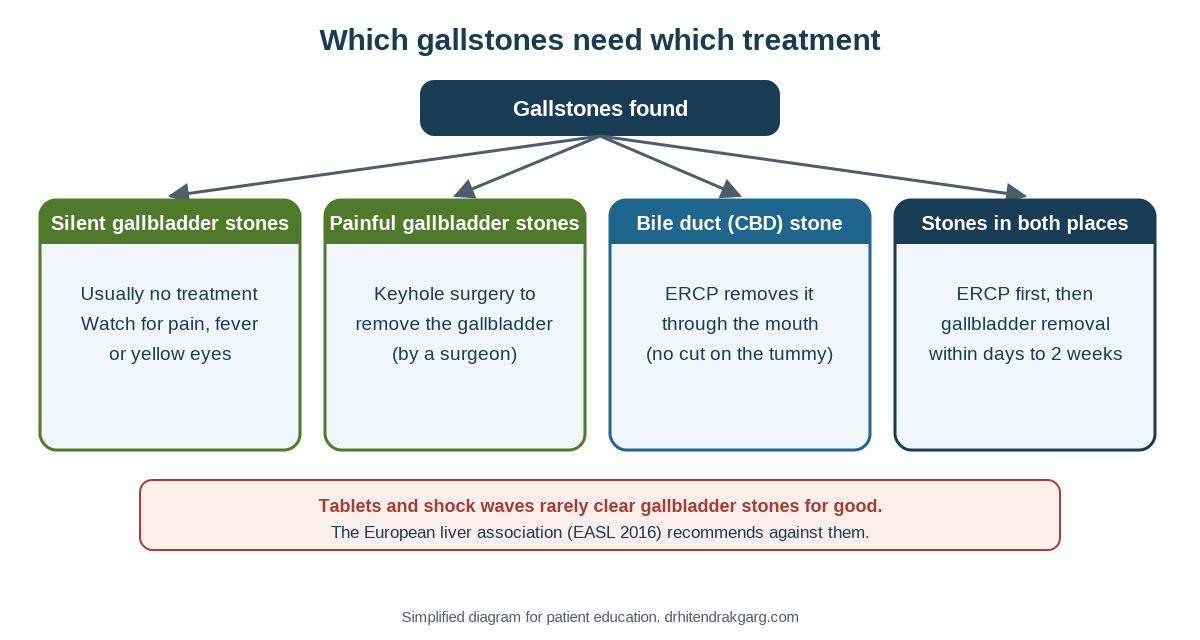
It depends on where the stone is. Stones in the bile duct (CBD stones) are usually removed without surgery, by an endoscopy called ERCP. Stones in the gallbladder are different. Silent gallbladder stones found by chance usually need no treatment at all. Gallbladder stones that cause pain usually need keyhole surgery to remove the gallbladder. Tablets that dissolve stones work in only about a quarter of carefully chosen people, and stones often come back. The European liver association does not recommend them. If you have stones in both places, the usual plan is ERCP first and gallbladder surgery soon after.
"Doctor, can't you just remove the stone with the camera, like you did for my mother?" It is a fair question. A relative may have had a stone taken out by endoscopy and gone home the next day. So why is a surgeon now talking about an operation? The answer is that the two stones were in different places. A stone in the bile duct and a stone in the gallbladder behave differently, and they are treated differently.
Where do gallstones form?
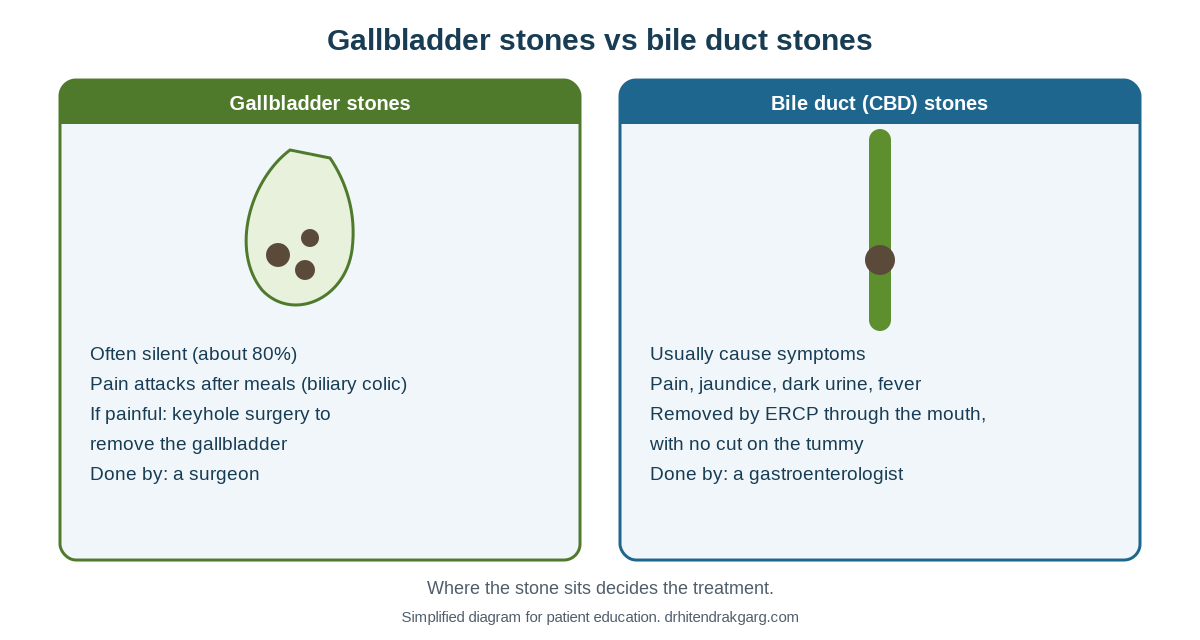
Most gallstones form in the gallbladder. Some of these later slip out into the common bile duct (CBD). That one fact explains most of this article.
The gallbladder is a small pouch under the liver. It stores bile and squeezes it out after meals to help digest fat. When bile has too much cholesterol, or does not empty well, it can harden into stones. These range from grains of sand to stones the size of a small egg.
The common bile duct is the tube that carries bile from the liver and gallbladder to the gut. A stone in the duct can block the flow of bile from the whole liver, not just from the gallbladder. That is why duct stones are more dangerous.
How common are gallstones?
Gallstones are very common, and most of them never cause a problem. The European gallstone guideline reports that 10% to 20% of adults in Western countries have gallbladder stones. In about 80% of them, the stones are silent (EASL Clinical Practice Guidelines on gallstones, Journal of Hepatology, 2016). Stones become more common with age, and women get them more often than men.
Stones in the bile duct are less common. The same guideline puts them at 3% to 16% of people who have gallbladder stones, with higher rates in older people. Britain's guideline gives 10% to 20% for people whose gallstones cause symptoms (Williams and colleagues, BSG guideline, Gut, 2017).
Gallstones symptoms: what does each type feel like?
Gallbladder stones mostly cause attacks of pain. Bile duct stones cause pain plus signs of a blocked duct, such as yellow eyes and dark urine.
Gallbladder stones
Most gallbladder stones cause no symptoms and are found on an ultrasound done for something else. When they do cause trouble, the typical gallstones pain is called biliary colic. The European guideline describes it as:
- Severe pain in the upper right or upper middle of the tummy
- Lasting at least 15 to 30 minutes, often more than an hour
- Often spreading to the right shoulder blade or back
- Often starting about an hour after a meal, or waking you at night
Pain lasting more than five hours usually means the gallbladder itself is inflamed (acute cholecystitis). That needs hospital care.
Here is something patients are often not told. Gas, bloating, burping and heartburn are not typical gallstone symptoms. People with and without stones get them equally. The European guideline notes that when these symptoms are present, they often carry on after the gallbladder is removed. If bloating is your main problem, read about the common causes of bloating before agreeing to surgery for silent stones.
Bile duct stones
Stones in the bile duct cause pain like biliary colic, but they also block bile. That brings yellow eyes or skin, urine the colour of strong tea, pale stools and itching. Fever with chills can mean the duct is infected. This is cholangitis, and it is an emergency. Only 5% to 12% of bile duct stones stay silent, according to the European guideline. Read more about CBD stone symptoms and treatment.
Gallbladder stone vs CBD stone: the key differences
The table puts the two side by side.
| Gallbladder stone | Bile duct (CBD) stone | |
|---|---|---|
| Where it sits | Inside the gallbladder pouch | In the main bile duct, between the liver and the gut |
| How common | 10% to 20% of adults in Western data; most silent | 3% to 16% of people with gallbladder stones |
| Typical symptoms | None, or attacks of upper right tummy pain after meals | Pain plus jaundice, dark urine, pale stools, itching |
| Main danger | Gallbladder inflammation (cholecystitis) | Infection of the duct (cholangitis) and pancreatitis |
| First test | Ultrasound | Liver blood tests and ultrasound; then MRCP, EUS or ERCP |
| Usual treatment | Nothing if silent; keyhole gallbladder removal if painful | ERCP to remove the stone, without surgery |
| Who treats it | Surgeon | Gastroenterologist trained in ERCP |
To find a duct stone, doctors often use an MRI scan of the bile ducts or an endoscopic ultrasound before ERCP. Our guide on ERCP vs MRCP explains why.
Is gallstones treatment without surgery possible?
For bile duct stones, yes: ERCP removes them through the mouth. For gallbladder stones that cause pain, usually no. Tablets and shock-wave treatment rarely work for long. For silent gallbladder stones, the honest answer is that most need no treatment of any kind.
Silent gallbladder stones: usually leave them alone
The European guideline does not recommend routine treatment for stones that cause no symptoms. Symptoms develop at a rate of 1% to 4% a year, and about 20% of people get symptoms within 20 years. Serious complications are rarer, at 0.1% to 0.3% a year. For most people, an operation carries more risk than the stones.
There are exceptions, and these are decided with a surgeon. They include a gallbladder polyp of 1 cm or more, and a calcified ("porcelain") gallbladder.
Tablets that dissolve stones
A medicine called ursodeoxycholic acid (UDCA) can slowly dissolve some small cholesterol stones. The results are poor. In the European guideline's figures, only 27% of people treated became free of stones. More than 40% saw their stones return within four years. Even when the stones did dissolve, 25% to 64% of people had them back within five years. UDCA did not reduce attacks of pain either. For these reasons, the guideline gives a strong recommendation against dissolving gallbladder stones with tablets.
UDCA still has other uses. Your doctor may prescribe it for other liver conditions, or to prevent stones during very fast weight loss. Don't stop your prescribed medicines without talking to your doctor.
Shock-wave treatment
Shock-wave lithotripsy (ESWL) breaks stones from outside the body, the way it is used for kidney stones. For gallbladder stones, the guideline reports that only 55% of carefully chosen people became stone-free, and stones often return. It is rarely used now for gallbladder stones.
Home remedies and "stone-dissolving" products
You may see juices, oils, cleanses or herbal products sold to "flush" or "melt" gallstones. There is no good evidence that any of them clear gallbladder stones. Some cleanses produce soft green lumps in the stool that look like stones but are made from the oil itself. The real risk is delay: a stone that moves into the bile duct while you wait can cause jaundice or pancreatitis.
Who needs gallbladder surgery?
Gallbladder surgery is usually advised when stones cause pain or complications. The operation is laparoscopic cholecystectomy. A surgeon removes the whole gallbladder through three or four small cuts, which is why the stones do not come back in the gallbladder afterwards.
- Repeated attacks of biliary colic: the European guideline notes that about half of people have more attacks after the first one
- Acute cholecystitis: early surgery, preferably within 72 hours of admission, is advised
- Gallstone pancreatitis
- A stone that has already moved into the bile duct
- A polyp of 1 cm or more, with or without stones
A note on gallbladder cancer in India
Gallbladder cancer is uncommon worldwide but more frequent in parts of India. A review of Indian data found it is common in North, North-East, Central and Eastern India and less common in the south and west. Gallstones were present in 80% of Indian patients with this cancer (Dutta and colleagues, Chinese Clinical Oncology, 2019). The same review notes that the number of cancers is far smaller than the number of people with gallstones. Silent stones alone are not a reason to panic. If you live in a high-risk region and have stones, it is reasonable to ask your surgeon whether this changes the advice for you.
What if you have stones in both places?
When stones are in both the gallbladder and the bile duct, the common plan is ERCP first, then keyhole gallbladder removal. The European liver association advises surgery within 72 hours of ERCP. The European endoscopy society says within two weeks (Manes and colleagues, ESGE guideline, Endoscopy, 2019).
Why not stop after ERCP? A Dutch trial followed people whose duct stones had been cleared. Biliary symptoms came back in 47% of those who kept their gallbladder, against 2% of those who had it removed (Boerma and colleagues, The Lancet, 2002).
Some hospitals clear the duct during the gallbladder operation instead, by surgery or by ERCP in the operating room. Which route is used depends on local skill. Both are accepted.
Can gallstones go away on their own?
Gallbladder stones rarely go away on their own. Small stones and sludge (thick bile) sometimes pass out of the gallbladder, but a stone that leaves the gallbladder has to travel down the bile duct to reach the gut, and that is exactly the journey that can cause jaundice or pancreatitis on the way.
Bile duct stones are a little different. Small ones can pass into the gut by themselves. When they do, the pain stops. Your liver tests may even return to normal. But you cannot know from the outside whether the stone has gone or is just sitting quietly higher up, which is why doctors confirm it with a scan rather than wait and see.
Slimming and diet need a word here. Losing weight slowly lowers the chance of new stones forming. Crash diets do the opposite: losing weight very fast is a known trigger for gallstones.
Questions to ask before you decide
Take these to your appointment. Short answers are fine.
- Is my stone in the gallbladder, the bile duct, or both?
- Are my symptoms really from the stones, or could something else explain them?
- Do my liver tests or scan suggest a duct stone that needs MRCP, EUS or ERCP?
- If I wait, what signs should bring me back at once?
- If I need both ERCP and surgery, who plans the timing between them?
Can you live a normal life without a gallbladder?
Yes. Bile still flows from the liver into the gut after the gallbladder is removed. It just trickles in steadily instead of being stored. Most people go back to their usual diet within a few weeks.
Some people notice looser stools after fatty meals for a while. A few have ongoing pain, often because the pain was not from the stones in the first place. That is why doctors are careful to link symptoms to stones before advising surgery.
Gallstones: myths and facts
| Myth | Fact |
|---|---|
| All gallstones must be removed. | Most silent gallbladder stones need no treatment. Only 1% to 4% a year start causing symptoms. |
| ERCP can take stones out of the gallbladder. | ERCP removes stones from the bile duct. It does not clear the gallbladder. |
| Tablets can melt my gallstones. | UDCA clears stones in only about 27% of carefully chosen people, and stones often return. The European guideline advises against it. |
| Gas and bloating mean my gallstones are acting up. | Bloating and burping are common with or without stones and often continue after surgery. |
| Juice or oil cleanses flush out stones. | There is no good evidence for this. The "stones" seen after a cleanse are often made from the oil. |
| Without a gallbladder, you cannot digest food. | Bile still reaches the gut. Most people eat normally within weeks. |
When should you see a doctor about gallstones?
See a doctor if you have repeated attacks of upper right tummy pain, or if an ultrasound has found stones and you are unsure what to do. Get emergency care for:
- Pain lasting more than five hours
- Fever or chills with tummy pain
- Yellow eyes or skin, or dark urine
- Severe pain going through to the back
If a duct stone is suspected, a gastroenterologist will plan the tests and ERCP. Read about the ERCP for bile duct stones service, and about endoscopic ultrasound, which can check for small stones the ultrasound missed. If your liver tests are abnormal, our liver function test guide explains what the results mean.
Frequently asked questions
Can gallstones be treated without surgery?
Stones in the bile duct can: they are removed by ERCP through the mouth. Gallbladder stones that cause pain usually need keyhole surgery, because tablets and shock-wave treatment rarely work for long. Silent gallbladder stones found by chance usually need no treatment.
What is the difference between a gallbladder stone and a CBD stone?
A gallbladder stone sits in the gallbladder pouch and is often silent. A CBD stone is in the main bile duct and usually causes pain, jaundice or infection. Gallbladder stones that cause pain are treated by surgery. CBD stones are removed by ERCP.
What does gallstones pain feel like?
Typical gallstone pain is severe pain in the upper right or middle of the tummy that lasts at least 15 to 30 minutes, often more than an hour. It may spread to the right shoulder blade and often starts after a meal or at night. Pain lasting more than five hours needs urgent care.
Can medicine dissolve gallstones?
A medicine called UDCA can dissolve some small cholesterol stones, but it clears them in only about 27% of people and stones often come back. The European liver association recommends against using it to treat gallbladder stones.
Should silent gallstones be removed?
Usually not. Only 1% to 4% of people with silent stones develop symptoms each year, and surgery carries its own risks. Exceptions, such as a large polyp or a porcelain gallbladder, are decided with a surgeon.
Can ERCP remove gallbladder stones?
No. ERCP removes stones from the bile duct. Stones inside the gallbladder are dealt with by removing the gallbladder, which a surgeon does by keyhole surgery.
Why remove the gallbladder after ERCP?
The gallbladder is where most duct stones come from. In a Dutch trial, 47% of people who kept their gallbladder after ERCP had symptoms again, compared with 2% who had it removed.

References
- European Association for the Study of the Liver. EASL Clinical Practice Guidelines on the prevention, diagnosis and treatment of gallstones. J Hepatol. 2016;65(1):146-181. Source
- Williams E, Beckingham I, El Sayed G, et al. Updated guideline on the management of common bile duct stones (CBDS). Gut. 2017;66(5):765-782. Source
- Dutta U, Bush N, Kalsi D, Popli P, Kapoor VK. Epidemiology of gallbladder cancer in India. Chin Clin Oncol. 2019;8(4):33. Source
- Manes G, Paspatis G, Aabakken L, et al. Endoscopic management of common bile duct stones: European Society of Gastrointestinal Endoscopy (ESGE) guideline. Endoscopy. 2019;51(5):472-491. Source
- Boerma D, Rauws EAJ, Keulemans YCA, et al. Wait-and-see policy or laparoscopic cholecystectomy after endoscopic sphincterotomy for bile-duct stones: a randomised trial. Lancet. 2002;360(9335):761-765. Source
Medical disclaimer: This article is for general education and is not a substitute for a consultation. Please see a doctor for advice about your own symptoms. Read our editorial policy.