ERCP Stent: Why It Is Placed, How Long It Stays and How It Is Removed
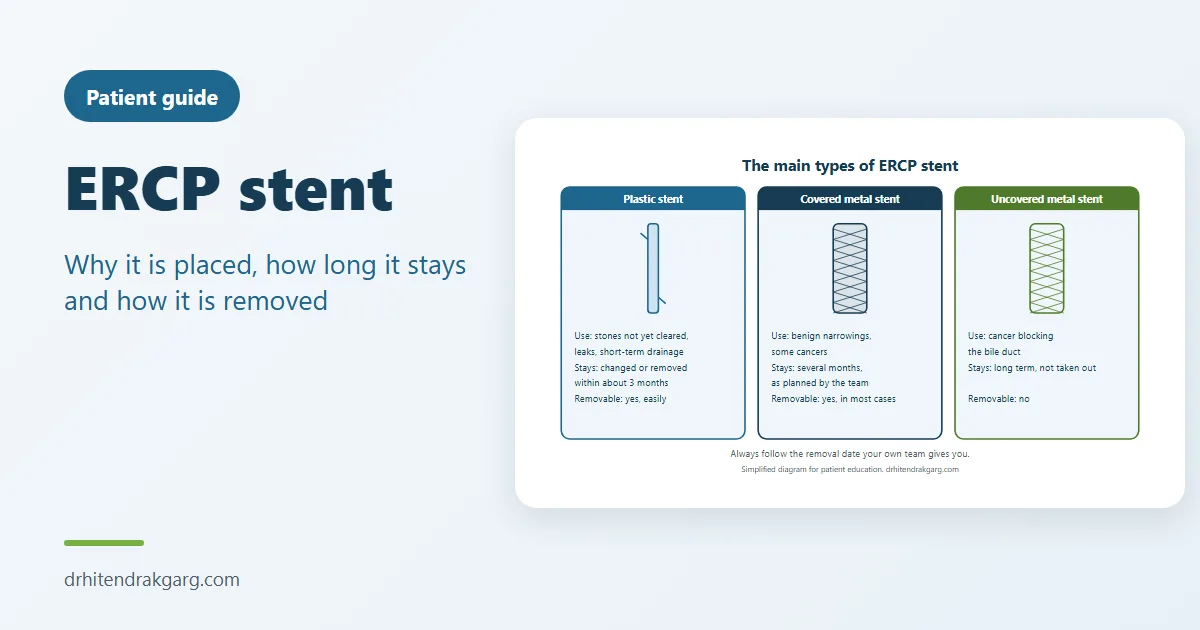
If you have had an ERCP, you may have gone home with a small tube left inside your bile duct. This guide explains what that stent does, how long it can safely stay, how it is taken out, and why a stent must never be forgotten.
In short
An ERCP stent is a thin plastic or metal tube placed in the bile duct or pancreatic duct during ERCP. It keeps bile flowing when a stone or a narrowing is in the way, or while a leak heals. Most plastic biliary stents are temporary. They are usually changed or removed within about three months, because they tend to clog after that. Removal is a short endoscopy under sedation, and most people go home the same day. Some metal stents are meant to stay for good. Fever with chills can mean a blocked stent and needs urgent care. So can yellow eyes or dark urine. Keep a note of the date your stent is due out.
The discharge summary says "CBD stenting done" and gives a date to come back. It is easy to put that paper in a drawer. The jaundice has gone and life moves on. This is where problems start. A plastic stent is a temporary part, a bit like a drain, and it has a use-by date. Here is what you need to know about yours.
What is an ERCP stent?
An ERCP stent is a small hollow tube placed inside the bile duct or the pancreatic duct during ERCP. It holds the duct open so that bile or pancreatic juice can drain into the gut.
The stent is pushed into place through the endoscope. One end sits in the duct. The other end pokes out a few millimetres into the duodenum, the first part of the small bowel, which is how the doctor can grab it later. You cannot feel it, and nothing shows on the outside of your body.
There are two main materials:
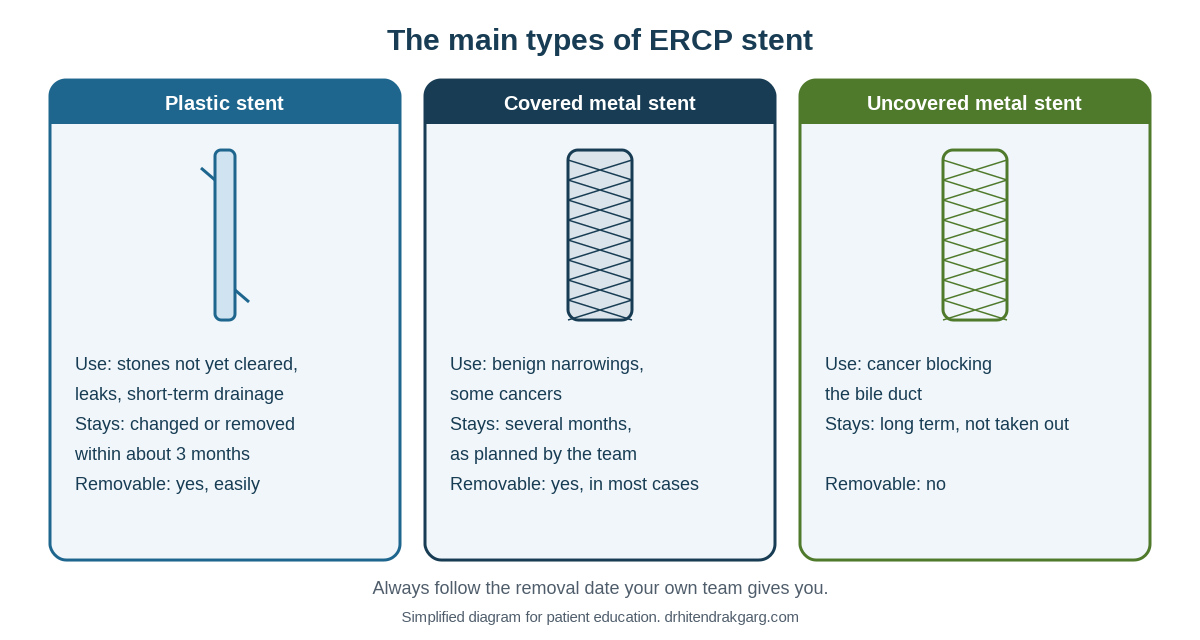
- Plastic stents: narrow and low-cost. They are easy to take out and are meant to be temporary.
- Metal stents (self-expanding metal stents, SEMS): a mesh tube that opens up to a much wider size inside the duct. Some are covered with a plastic film so they can be removed later. Uncovered ones grow into the duct wall and are usually left in for good.
Why is a stent placed during ERCP?
A stent is placed during ERCP when bile cannot drain properly and the cause cannot be fixed that day. It buys time and keeps the liver safe.
Common reasons include:
- A stone that could not be removed: the stone was too big or firmly wedged, or there were too many to clear in one go. A stent keeps bile flowing until a second ERCP. The European guideline on bile duct stones supports a temporary plastic stent in this situation (Manes and colleagues, ESGE guideline, Endoscopy, 2019). Read about CBD stone treatment by ERCP.
- Cholangitis: when infected bile must be drained fast and the patient is too unwell for a long procedure
- A narrowing (stricture): often from scarring. This can follow surgery or a liver transplant, and chronic pancreatitis can do it too. Benign narrowings are often stretched over months with several plastic stents or one covered metal stent.
- A growth blocking the duct: most often a cancer of the pancreas or the bile duct. Here a stent relieves jaundice and itching.
- A bile leak: after gallbladder or liver surgery. A short-term stent lets the leak heal.
- To prevent pancreatitis: a tiny pancreatic stent may be left for a few days in people at high risk of pancreatitis after ERCP. European guidance recommends this for selected high-risk patients (Dumonceau and colleagues, ESGE guideline on ERCP adverse events, Endoscopy, 2020).
Read about the procedure in general on our ERCP procedure page.
Types of ERCP stent compared
The table shows the usual pattern. Your own plan may differ, so always follow the date your team gives you.
| Stent | Typical use | Usual time in place | Removable? |
|---|---|---|---|
| Plastic biliary stent | Stones not yet cleared, leaks, benign narrowings, short-term drainage | Changed or removed within about 3 months | Yes, easily |
| Several plastic stents side by side | Stretching a benign narrowing | Exchanged in rounds, often over about a year | Yes |
| Fully covered metal stent | Benign narrowings; some cancers | Several months, as planned by the team | Yes, in most cases |
| Uncovered metal stent | Cancer blocking the duct | Long term; not taken out | No |
| Small pancreatic stent | Preventing pancreatitis after ERCP | Days to a few weeks; often falls out by itself | Checked by X-ray; removed if still there |
The European stenting guideline recommends either several plastic stents or a fully covered metal stent for benign narrowings of the bile duct (Dumonceau and colleagues, ESGE biliary stenting guideline, Endoscopy, 2018). The choice depends on where the narrowing is and on your team's experience.
Plastic or metal: how doctors choose
The choice between a plastic and a metal stent depends mostly on why the stent is needed and how long it has to work.
For a stone that will be cleared at a second ERCP, a plastic stent is the usual choice. It is cheap, it does its job for a few weeks, and it slides out easily. Nobody needs a metal stent for that.
Benign narrowings are a longer project. The duct has to be stretched and held open for months so the scar can remodel. Some teams do this with two, three or more plastic stents side by side, exchanged in rounds. Others use one fully covered metal stent and take it out later. Both are accepted by the European guideline, and the team picks based on where the narrowing sits and their own experience.
When cancer blocks the duct and an operation is not possible, the aim changes. Now the stent has to keep the jaundice away for as long as possible with as few hospital visits as possible. Metal stents are much wider than plastic ones and generally stay open longer, so they are often preferred when a person is expected to live more than a few months. A plastic stent may be used first while the diagnosis is still being confirmed, or when surgery is planned soon.
Cost matters to many families in India, and it is a fair thing to ask about. A metal stent costs more on the day, but it may mean fewer repeat procedures. Ask the team to explain the trade-off for your situation.
How long can a biliary stent stay?
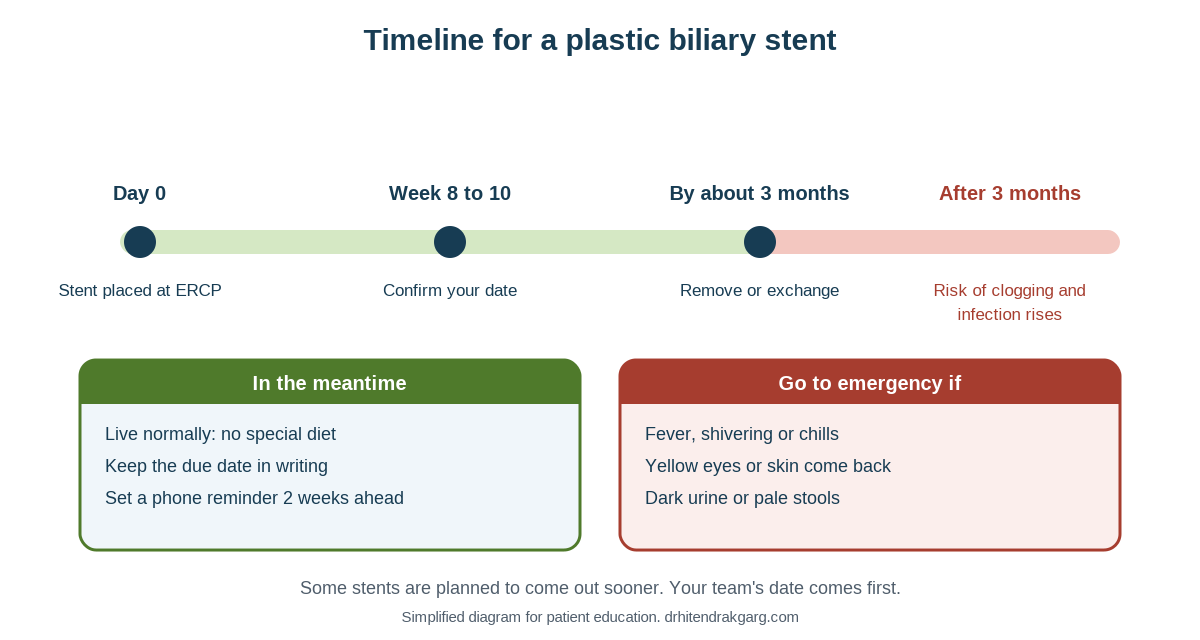
A plastic biliary stent should usually be changed or removed within about three months. A metal stent can stay much longer, and an uncovered one is usually left in for good.
Plastic stents clog over time. Bacteria and bile form a sludge that slowly blocks the inside of the tube. A review in Clinical Endoscopy reports that 10 Fr plastic stents (about 3.3 mm wide) stay open for a median of 4 to 5 months, with the risk of blockage rising sharply after 3 months. That is why many centres change them every 3 months on a fixed schedule, rather than waiting for trouble (Kwon and Lehman, Clinical Endoscopy, 2016).
Some people need their stent out sooner. For example, if the stent was placed only because a stone could not be cleared, the second ERCP is often planned within weeks.
What to expect after a stent is placed
Recovery after a stent is the same as recovery after any ERCP. Most people go home the same day or the next morning.
A sore throat and a little bloating are common for a day. If you had jaundice, the yellow colour fades over days to a few weeks, and the itching usually eases first. Your doctor may repeat liver blood tests to check that bile is draining well.
The first few hours matter most. Pancreatitis after ERCP usually shows itself within that time as tummy pain that keeps getting worse, often spreading to the back. Report it straight away. Do not wait until morning.
What happens if a stent is left in too long?
A stent left in too long can block or move, and infection often follows. Doctors call these "forgotten stents", and they are seen more often than you might expect.
A Korean study looked at 38 patients whose plastic biliary stents had stayed in for more than a year. Almost all of them, 94.7%, came in with cholangitis, an infection of the bile duct. Stones had often formed on and around the stent. The stents could still be removed by endoscopy in 92.1% of cases, but some patients needed other procedures (Sohn and colleagues, World Journal of Gastroenterology, 2017).
Other problems include the stent slipping up into the duct or down into the bowel, and, rarely, a tear in the bowel wall. Most of these are avoidable. All it takes is coming back on time.
How to make sure your stent is not forgotten
- Ask for the stent type and the date it is due out, in writing
- Put a reminder on your phone two weeks before that date
- Keep a photo of the discharge summary on your phone
- Tell a family member, especially if you are elderly or live alone
- If you move city or change doctor, tell the new doctor about the stent
Signs of a blocked stent
A blocked stent stops bile from draining, which can quickly lead to infection. Go to an emergency department if you have a stent and notice:
- Fever, shivering or chills
- Yellow eyes or skin coming back
- Dark urine or pale stools
- Pain in the upper right tummy
- Itching that returns
Tell the emergency team that you have a bile duct stent and when it was placed. A blocked stent is usually treated with a fresh ERCP to change it, along with antibiotics.
How is a biliary stent removed?
Biliary stent removal is a short endoscopy. The same kind of scope used for ERCP passes through the mouth into the duodenum, the doctor grabs the end of the stent with a small snare or forceps, and pulls it out with the scope.
What to expect:
- Fast for about six hours beforehand.
- You are given sedation, so you are drowsy and comfortable.
- If only the stent is being removed, the procedure is usually short.
- If the plan is to clear a remaining stone or put in a fresh stent, a full ERCP is done in the same sitting, which takes longer.
- Most people go home the same day once the sedation wears off.
If the stent has moved up into the duct, removing it is harder and may need special tools. This is one more reason to keep to the schedule.
Some small pancreatic stents fall out by themselves and pass in the stool, which you will not notice. An X-ray of the tummy after a week or two shows whether it has gone. If it is still there, it is removed by endoscopy.
Living with a stent
Most people with a stent live normally. You do not need a special diet. Work and travel are fine. So is exercise.
A few practical points:
- Scans: plastic stents are safe in an MRI machine. Most modern metal stents are too, but always tell the radiology team you have one.
- Travel: carry your discharge summary, and know the due date for removal before booking a long trip.
- Medicines: carry on with your usual medicines unless your doctor says otherwise. Don't stop your prescribed medicines without talking to your doctor.
- Gallbladder: if the stent was placed for a stone, gallbladder surgery may also be planned. See gallbladder stones vs bile duct stones.
ERCP stents: myths and facts
| Myth | Fact |
|---|---|
| Once I feel well, the stent can stay. | Feeling well does not mean the stent is open. Plastic stents tend to clog after about 3 months. |
| A stent gets rid of the stone. | A stent only drains bile past the stone. The stone usually still needs to be removed. |
| Stent removal needs an operation. | Removal is a short endoscopy under sedation, usually as a day case. |
| All stents have to come out. | Uncovered metal stents placed for cancer are usually meant to stay for good. |
| I will feel it if my stent blocks. | Sometimes the first sign is fever with chills, which can be serious. Do not wait for pain. |
| I cannot have an MRI with a stent. | Plastic stents are safe in MRI. Most modern metal stents are too, but tell the radiology team. |
Questions to ask about your stent
- Is my stent plastic or metal, and is it in the bile duct or the pancreatic duct?
- Why was it placed, and what is the plan to fix the cause?
- What is the exact date it should be changed or removed?
- Who do I call if I get a fever or yellow eyes?
- Will removal be a quick endoscopy, or a full ERCP?
Many people with stents also had tests like MRCP before their ERCP. Our guide on ERCP vs MRCP explains how those tests differ. If the stent was placed for a narrowing seen on scans, endoscopic ultrasound is often used to look at it more closely. And if jaundice is part of the story, our liver function test guide explains how bilirubin and ALP change as a blocked duct clears.
Frequently asked questions
What is an ERCP stent?
An ERCP stent is a thin plastic or metal tube placed in the bile duct or pancreatic duct during ERCP. It keeps the duct open so bile can drain when a stone or a narrowing blocks the way, or while a leak heals.
How long can a biliary stent stay in?
A plastic biliary stent is usually changed or removed within about three months, because the risk of blockage rises after that. Covered metal stents can stay for several months, and uncovered metal stents placed for cancer are usually left in for good. Follow the date your own team gives you.
How is a biliary stent removed?
By a short endoscopy under sedation. The doctor passes the scope through the mouth to the duodenum, grabs the end of the stent with a snare or forceps, and pulls it out. Most people go home the same day.
Is biliary stent removal painful?
You are given sedation, so most people are comfortable and remember little. A mild sore throat afterwards is common. If a full ERCP is done at the same time, the recovery is the same as after ERCP.
What happens if a stent is not removed?
A plastic stent left too long can clog. Infection of the bile duct is the most common result. New stones can form, and the stent can move. In one study of stents left in for over a year, 94.7% of patients had cholangitis.
What are the signs of a blocked biliary stent?
Fever with chills, yellow eyes or skin, dark urine, pale stools, itching or pain in the upper right tummy. These need urgent medical care. Tell the team you have a stent.
Can I eat normally with a bile duct stent?
Yes. No special diet is needed with a stent. Eat as your doctor advises for any other condition you have, such as gallstones or pancreatitis.

References
- Manes G, Paspatis G, Aabakken L, et al. Endoscopic management of common bile duct stones: European Society of Gastrointestinal Endoscopy (ESGE) guideline. Endoscopy. 2019;51(5):472-491. Source
- Dumonceau JM, Kapral C, Aabakken L, et al. ERCP-related adverse events: European Society of Gastrointestinal Endoscopy (ESGE) Guideline. Endoscopy. 2020;52(2):127-149. Source
- Dumonceau JM, Tringali A, Papanikolaou IS, et al. Endoscopic biliary stenting: indications, choice of stents, and results: European Society of Gastrointestinal Endoscopy (ESGE) Clinical Guideline, updated October 2017. Endoscopy. 2018;50(9):910-930. Source
- Kwon CI, Lehman GA. Mechanisms of Biliary Plastic Stent Occlusion and Efforts at Prevention. Clin Endosc. 2016;49(2):139-146. Source
- Sohn SH, Park JH, Kim KH, Kim TN. Complications and management of forgotten long-term biliary stents. World J Gastroenterol. 2017;23(4):622-628. Source
Medical disclaimer: This article is for general education and is not a substitute for a consultation. Please see a doctor for advice about your own symptoms. Read our editorial policy.