Bile Duct (CBD) Stones: Symptoms and Removal by ERCP
A stone stuck in the main bile duct can cause pain, jaundice and fever. This guide explains how a CBD stone is found, how ERCP takes it out through the mouth with no cut on the tummy, what the risks are, and what happens next.
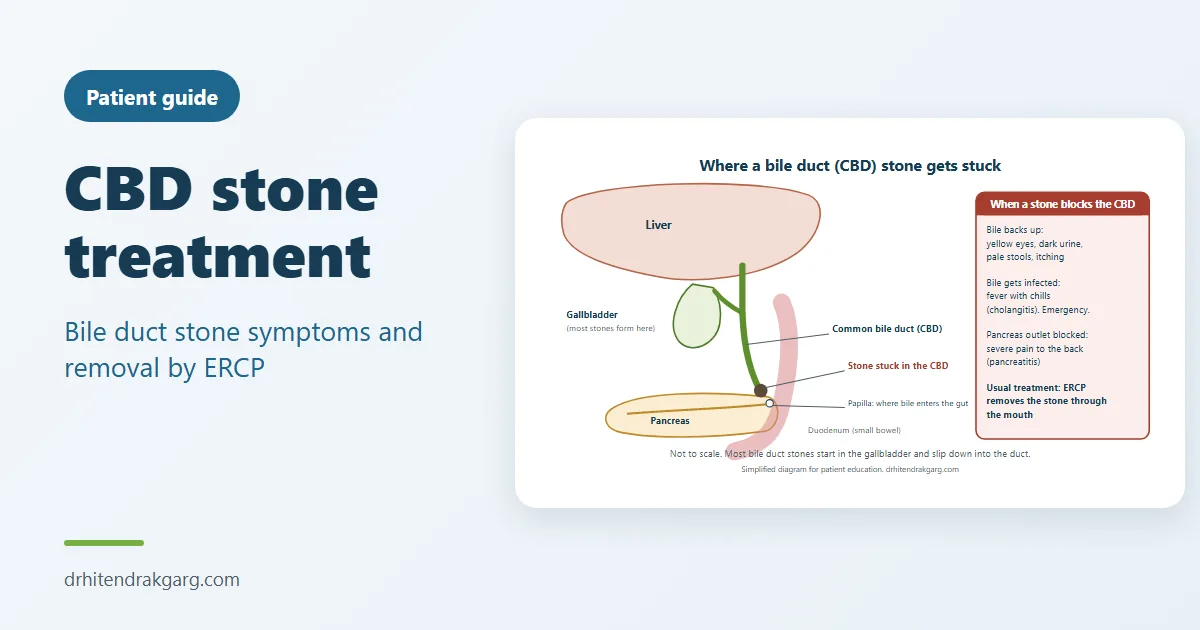
In short
A CBD stone is a gallstone in the common bile duct, the tube that carries bile from the liver to the gut. The main treatment is ERCP. A thin, flexible tube with a camera goes in through the mouth, and the doctor pulls the stone out with a small balloon or basket. There is no cut on the tummy. Standard ERCP clears most stones in one or two sittings. Most people go home the same day or the next morning. If you still have a gallbladder, a surgeon usually removes it soon after, because stones tend to come back. Get urgent care for yellow eyes with fever and chills.
Many people first hear the words "CBD stone" in an emergency room. They came in with tummy pain, and now a doctor is talking about yellow eyes, a blocked duct and a test called ERCP. It is a lot to take in at once. This guide walks through it step by step: what the stone is, how it is found, how it comes out, and what to expect in the weeks after.
What is a CBD stone?
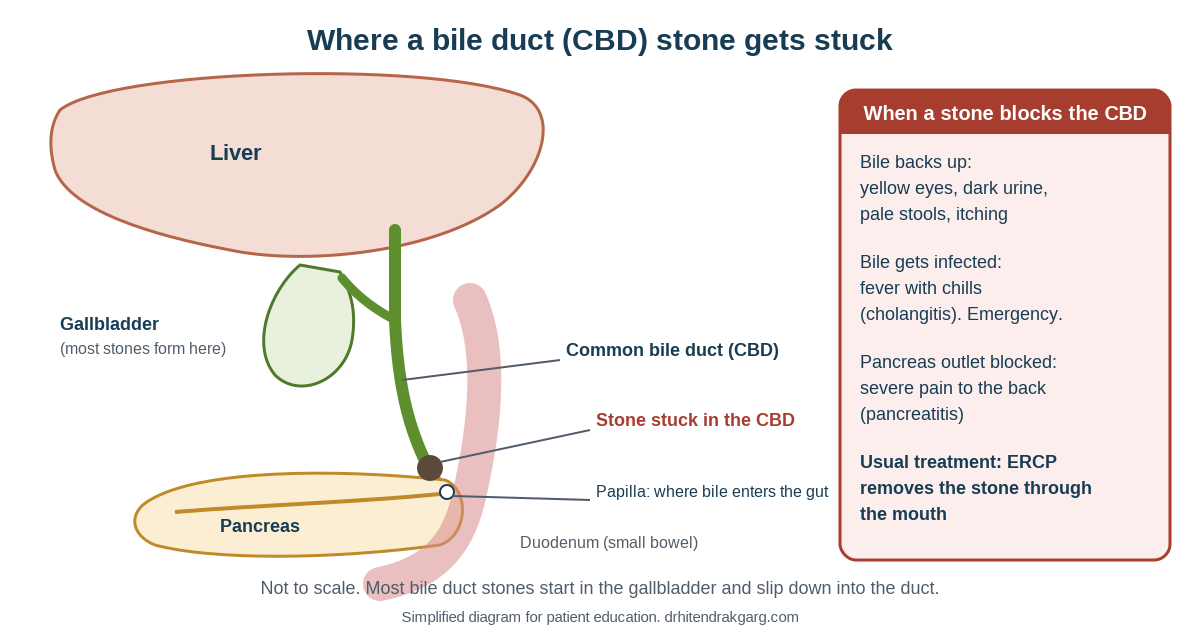
A CBD stone is a gallstone that has got into the common bile duct. Doctors call this choledocholithiasis. The common bile duct (CBD) is a narrow tube, a few millimetres wide, that carries bile from the liver and gallbladder down into the duodenum, the first part of the small bowel.
Most CBD stones start life in the gallbladder and slip down into the duct. A few form inside the duct itself, usually when it is wide and bile flows slowly. Older people get them more often.
They are not rare. Britain's guideline on bile duct stones estimates that 10% to 20% of people with gallstones that cause symptoms also have stones in the CBD (Williams and colleagues, British Society of Gastroenterology guideline, Gut, 2017).
What are the symptoms of a CBD stone?
The usual CBD stone symptoms are pain in the upper tummy, yellow eyes or skin, and dark urine. Unlike gallbladder stones, which are often silent, stones in the bile duct cause trouble in most people. The European gallstone guideline says only 5% to 12% stay free of symptoms (EASL Clinical Practice Guidelines on gallstones, Journal of Hepatology, 2016).
- Pain: in the upper right or middle of the tummy. It lasts more than half an hour and can go on for several hours. Changing position does not ease it.
- Jaundice: yellow eyes or skin, because bile backs up into the blood
- Dark urine and pale stools: urine the colour of strong tea, and stools that look grey or clay-coloured
- Itching: all over the body, often worse at night
- Nausea and vomiting
Some people have only one of these. A small stone can pass on its own and the pain settles, which can make it seem like the problem is gone. Often it is not.
Signs that need emergency care
A blocked bile duct can get infected. This is called cholangitis, and it is serious. Go to an emergency department straight away if tummy pain or jaundice comes with any of these:
- Fever with shivering or chills
- Confusion, drowsiness or feeling faint
- Severe pain going through to the back, which can mean the stone has triggered pancreatitis
The Tokyo Guidelines, used worldwide to diagnose cholangitis, are built on exactly this mix: signs of infection, jaundice and a blocked duct on a scan (Kiriyama and colleagues, Tokyo Guidelines 2018, Journal of Hepato-Biliary-Pancreatic Sciences). Infected bile needs to be drained quickly, usually by ERCP.
How are bile duct stones found?
Bile duct stones are usually found with a blood test and an ultrasound first. A more detailed scan follows when those are not clear.
- Liver function tests: bilirubin, ALP and GGT rise when the duct is blocked. Read what the numbers mean in our liver function test guide.
- Ultrasound of the abdomen: the first scan. It shows gallbladder stones well and picks up a widened bile duct. It can miss a stone sitting low in the duct, behind gas in the bowel.
- MRCP or endoscopic ultrasound (EUS): used when the chance of a duct stone is in the middle, neither high nor low. Both can show small stones without the risks of ERCP.
The American Society for Gastrointestinal Endoscopy (ASGE) sorts patients by risk. People with a stone already seen on a scan, or with cholangitis, or with a bilirubin above 4 mg/dL plus a widened duct, are high risk. They can go straight to ERCP. Others usually get MRCP or EUS first (Buxbaum and colleagues, ASGE guideline on choledocholithiasis, Gastrointestinal Endoscopy, 2019). Our guide on ERCP vs MRCP explains this choice in more detail.
How does ERCP remove a CBD stone?
ERCP removes a CBD stone through the mouth, with no cut on the skin. The full name is endoscopic retrograde cholangiopancreatography. It is the standard CBD stone treatment in most hospitals. Read about the procedure in general on our ERCP procedure page.
Here is what happens, step by step.
- Before: you fast for about six hours. The team checks your blood tests and medicines, especially blood thinners. Most centres also give a painkiller suppository (diclofenac or indomethacin) just before the test, because European guidance shows it lowers the risk of pancreatitis afterwards.
- Sedation: you are given medicine through a drip to make you deeply sleepy, or a full anaesthetic in some cases.
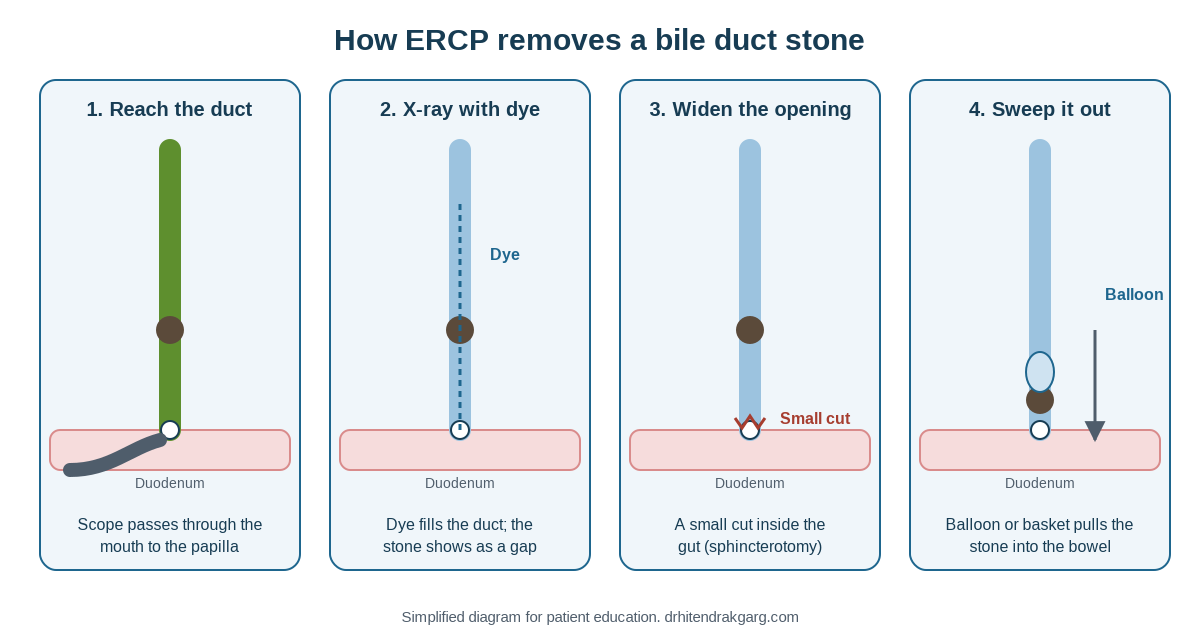
- The scope: a side-viewing endoscope (a duodenoscope) passes through the mouth and stomach into the duodenum. The doctor finds the papilla, the small opening where the bile duct drains.
- The X-ray picture: a thin tube goes into the bile duct and dye is injected. On X-ray, the duct lights up and any stone shows as a dark gap.
- The cut (sphincterotomy): a small electric wire widens the opening of the duct by a few millimetres. This is inside the gut. You do not feel it.
- Removal: a small balloon or wire basket is passed up past the stone and pulled back down, sweeping it out into the bowel. It then passes out in the stool.
- A stent, if needed: if the duct cannot be cleared that day, a small plastic tube (a stent) is left in to keep bile flowing.
The procedure usually takes 30 to 60 minutes. Dr. Hitendra K Garg performs ERCP for bile duct and pancreatic disease at Indraprastha Apollo Hospitals, Sarita Vihar, New Delhi. Before the day, ask the team who will do your procedure and what the plan is if the stone does not come out the first time. Both are fair questions.
What if the stone is large or hard to remove?
Most stones come out with a balloon or basket. Large stones, or stones wedged above a narrowing, are harder. The European guideline on bile duct stones lists the main options (Manes and colleagues, ESGE guideline, Endoscopy, 2019):
- Large balloon dilation: stretching the duct opening with a wider balloon after a small cut, so a bigger stone can pass
- Mechanical lithotripsy: a strong basket that crushes the stone into pieces
- Cholangioscopy with laser or shock-wave lithotripsy: a tiny camera goes up inside the bile duct, and the stone is broken under direct view. Some centres offer this for the hardest stones.
- A temporary stent: when the duct cannot be cleared, a plastic stent drains bile until a second ERCP. Stones sometimes shrink or loosen in the meantime. Read why this tube must not be forgotten in our guide to the ERCP stent.
Is bile duct stone removal without surgery possible?
Yes. For most people, bile duct stone removal without surgery is the usual route, and ERCP is how it is done. The European guideline names endoscopic sphincterotomy and stone extraction as a recommended treatment. Surgery to open the bile duct is now kept for special situations.
There is a catch, and it confuses many patients. Taking the stone out of the duct does not deal with the gallbladder, where most of these stones came from. That part usually still needs an operation (see below). If you want to understand why gallbladder stones and duct stones are handled so differently, read gallbladder stones vs bile duct stones.
The table compares the three ways a bile duct can be cleared.
| ERCP | Laparoscopic bile duct exploration | Drain through the skin (PTBD) | |
|---|---|---|---|
| How it is done | Endoscope through the mouth | Keyhole surgery, usually at the same time as gallbladder removal | Needle and tube through the skin into the liver, under X-ray |
| Who does it | Gastroenterologist trained in ERCP | Surgeon | Interventional radiologist |
| Cut on the skin | None | Small keyhole cuts | Small puncture |
| Usual stay | Same day or overnight | As for gallbladder surgery | Several days; a bag may stay for a while |
| Main risk | Pancreatitis | Bile leak; risks of surgery | Bleeding, bile leak, tube problems |
| When it is used | First choice in most hospitals | Where the surgical team has this skill | When ERCP is not possible, for example after some stomach operations |
How well does ERCP work for CBD stones?
ERCP works well for most CBD stones. Standard techniques clear the duct in the large majority of patients, often in a single session. A smaller group needs a second ERCP or one of the extra methods above. The European gallstone guideline notes that a few people need surgery or a drain through the skin instead, for example when ERCP has failed or after some kinds of weight-loss surgery.
What happens if a stone is left alone? The European guideline says more than 25% of people with untreated duct stones go on to develop complications, often serious ones. That is why doctors treat duct stones even when the pain has settled.
What are the risks of ERCP?
ERCP is a bigger procedure than a routine endoscopy, and it carries real risks. Most problems are mild and settle in hospital.
A review of 21 studies covering 16,855 patients found that 6.85% had a complication linked to ERCP. Pancreatitis was the most common, at 3.47%. The death rate was 0.33%, often in people who were already very ill (Andriulli and colleagues, American Journal of Gastroenterology, 2007).
- Pancreatitis: inflammation of the pancreas, causing tummy pain a few hours later. Most cases are mild and need a day or two of drip fluids.
- Bleeding: from the small cut. It is usually stopped during the same procedure.
- Infection: of the bile duct or gallbladder
- Perforation: a tear in the bowel or duct. It is rare, but it may need surgery.
- Sedation problems: mainly in people with heart or lung disease
Two steps lower the pancreatitis risk. European guidance recommends a 100 mg diclofenac or indomethacin suppository just before ERCP for everyone who can safely take it. For people at higher risk, a tiny temporary stent can be placed in the pancreatic duct (Dumonceau and colleagues, ESGE guideline on ERCP adverse events, Endoscopy, 2020). Because of these risks, ERCP is used to treat a stone that is likely to be there, not to hunt for one that might not be.
What is recovery like after ERCP?
Recovery after ERCP is usually quick. Many people go home the same evening. Others stay one night, especially after a long procedure or if they were unwell with cholangitis.
- The throat may feel sore for a day.
- You start with sips of water. Light food follows once the team is happy there is no pancreatitis.
- Do not drive or sign anything important for 24 hours after sedation.
- Jaundice and itching fade over days to a few weeks as the bilirubin falls.
After you go home, return to hospital if you get severe tummy pain, fever, black stools, vomiting blood or worsening yellow eyes.
Why is the gallbladder removed after ERCP?
The gallbladder is usually removed after ERCP because it is the source of most bile duct stones. If it stays, new stones are likely to drop into the duct again.
A trial in the Netherlands made this clear. After ERCP cleared their duct stones, 47% of people who kept their gallbladder had biliary symptoms come back. Only 2% of those who had it removed did (Boerma and colleagues, The Lancet, 2002).
Timing matters too. The European liver association advises keyhole gallbladder removal (laparoscopic cholecystectomy) within 72 hours of ERCP. The European endoscopy society says within two weeks. In practice the surgeon and your gastroenterologist agree on a date, often during the same admission. The operation is done by a surgeon.
There are exceptions. In some very elderly or frail people, the risks of surgery outweigh the benefit, and the team may decide to leave the gallbladder alone and watch.
Can CBD stones come back?
Yes, sometimes. The European guideline reports new bile duct stones in 5% to 20% of people after sphincterotomy. They can usually be removed by ERCP again. Stones are more likely to return when the duct is very wide, or when there is a narrowing or a pouch near the papilla.
There is no medicine proven to stop them coming back. The most useful protection is removing the gallbladder when advised, and acting quickly if pain or jaundice returns.
CBD stones: myths and facts
| Myth | Fact |
|---|---|
| A CBD stone always needs open surgery. | Most are removed by ERCP through the mouth, with no cut on the tummy. |
| Once the pain stops, the stone has gone. | A stone can sit quietly and block the duct again. The European guideline says over 25% of untreated duct stones lead to complications. |
| After ERCP, the gallbladder can always stay. | In a Dutch trial, symptoms came back in 47% of people who kept it, against 2% who had it removed. |
| Medicines can dissolve a bile duct stone. | No medicine reliably clears a stone from the bile duct. ERCP or surgery is needed. |
| ERCP is just a scan. | ERCP is a treatment procedure with real risks. Scans like MRCP are used first when the diagnosis is unclear. |
| Yellow eyes with fever can wait until morning. | Jaundice with fever and chills can be cholangitis. It needs emergency care. |
Questions to ask before your ERCP
Write these down and take them to your appointment. The answers will help you know what to expect.
- How sure are we that there is a stone? Do I need an MRCP or EUS first?
- Will I have sedation or a general anaesthetic?
- Which of my medicines should I pause, and for how long?
- What happens if the stone does not come out the first time?
- Will a stent be left in? If so, when does it need to come out?
- When should my gallbladder be removed, and who will do it?
Don't stop your prescribed medicines without talking to your doctor. Blood thinners and diabetes medicines often need a plan before ERCP, but the plan should come from your doctor.
The bottom line on CBD stone treatment
A stone in the bile duct is common and treatable. ERCP is the usual CBD stone treatment and avoids open surgery for most people. It carries a small but real risk, so the test is chosen with care. In most cases the gallbladder should come out afterwards to stop the stones returning. If tests have found raised bilirubin or a widened duct, read about endoscopic ultrasound, which can check for small stones, and the wider role of a liver specialist when jaundice is the main problem.
Frequently asked questions
What is the treatment for a CBD stone?
The main CBD stone treatment is ERCP. An endoscope passes through the mouth into the gut, the opening of the bile duct is widened, and the stone is pulled out with a balloon or basket. No cut on the tummy is needed. If you still have your gallbladder, a surgeon usually removes it soon after so new stones do not drop into the duct.
Can a bile duct stone be removed without surgery?
Yes. Most bile duct stones are removed by ERCP, which is an endoscopy, not an operation. Large or stuck stones may need crushing or a second ERCP. Surgery is used when ERCP fails or cannot reach the duct.
What are the symptoms of a CBD stone?
Common CBD stone symptoms are pain in the upper right or middle tummy lasting more than half an hour, yellow eyes or skin, dark urine, pale stools and itching. Fever with chills means the duct may be infected. That needs emergency care.
Is ERCP painful?
You are given sedation or an anaesthetic, so most people do not remember the procedure. A sore throat and some bloating are common for a day. Tummy pain that gets worse a few hours later can be a sign of pancreatitis and should be reported straight away.
How long does it take to recover after ERCP for a CBD stone?
Many people go home the same day or the next morning and are back to normal activity in a day or two. Jaundice and itching fade over days to weeks. Recovery takes longer if there was cholangitis or pancreatitis.
Do I need my gallbladder removed after ERCP?
Usually yes, if you have gallbladder stones. In one trial, 47% of people who kept their gallbladder after ERCP had symptoms again, compared with 2% of those who had it removed. Very frail people are sometimes advised to keep it.
Can CBD stones come back after ERCP?
They can. New duct stones appear in about 5% to 20% of people after sphincterotomy, according to the European gallstone guideline. They can usually be removed by ERCP again.

References
- Williams E, Beckingham I, El Sayed G, et al. Updated guideline on the management of common bile duct stones (CBDS). Gut. 2017;66(5):765-782. Source
- European Association for the Study of the Liver. EASL Clinical Practice Guidelines on the prevention, diagnosis and treatment of gallstones. J Hepatol. 2016;65(1):146-181. Source
- Kiriyama S, Kozaka K, Takada T, et al. Tokyo Guidelines 2018: diagnostic criteria and severity grading of acute cholangitis. J Hepatobiliary Pancreat Sci. 2018;25(1):17-30. Source
- Buxbaum JL, Abbas Fehmi SM, Sultan S, et al. ASGE guideline on the role of endoscopy in the evaluation and management of choledocholithiasis. Gastrointest Endosc. 2019;89(6):1075-1105.e15. Source
- Manes G, Paspatis G, Aabakken L, et al. Endoscopic management of common bile duct stones: European Society of Gastrointestinal Endoscopy (ESGE) guideline. Endoscopy. 2019;51(5):472-491. Source
- Andriulli A, Loperfido S, Napolitano G, et al. Incidence rates of post-ERCP complications: a systematic survey of prospective studies. Am J Gastroenterol. 2007;102(8):1781-1788. Source
- Dumonceau JM, Kapral C, Aabakken L, et al. ERCP-related adverse events: European Society of Gastrointestinal Endoscopy (ESGE) Guideline. Endoscopy. 2020;52(2):127-149. Source
- Boerma D, Rauws EAJ, Keulemans YCA, et al. Wait-and-see policy or laparoscopic cholecystectomy after endoscopic sphincterotomy for bile-duct stones: a randomised trial. Lancet. 2002;360(9335):761-765. Source
Medical disclaimer: This article is for general education and is not a substitute for a consultation. Please see a doctor for advice about your own symptoms. Read our editorial policy.